

Home / Jamilah Jewels Blog | Moissanite, Jewelry Guides and Buying Advice / Moissanite vs White Sapphire: Which Is Better for Earrings?
Moissanite vs White Sapphire: Which Is Better for Earrings?
October 12, 2026

The short answer: moissanite is harder, far more brilliant and usually cheaper than white sapphire, so for stud earrings moissanite wins on almost every measure that matters. White sapphire's one real advantage is that it looks quieter, which is a genuine preference and not a flaw.
Almost every moissanite versus white sapphire article you will find is written about engagement rings. That is useful if you are buying a ring, and close to useless if what you actually want is a pair of studs you will wear five days a week. Earrings sit at a different distance from the eye, catch different light, and get judged on how they read across a room rather than how they look on a hand at arm's length. So here is the same comparison, answered for earrings.
We should say upfront that Jamilah Jewels sells moissanite and sterling silver, not white sapphire. That is a reason to check the numbers below rather than take our word for them, which is why the measurable ones are all here in full.
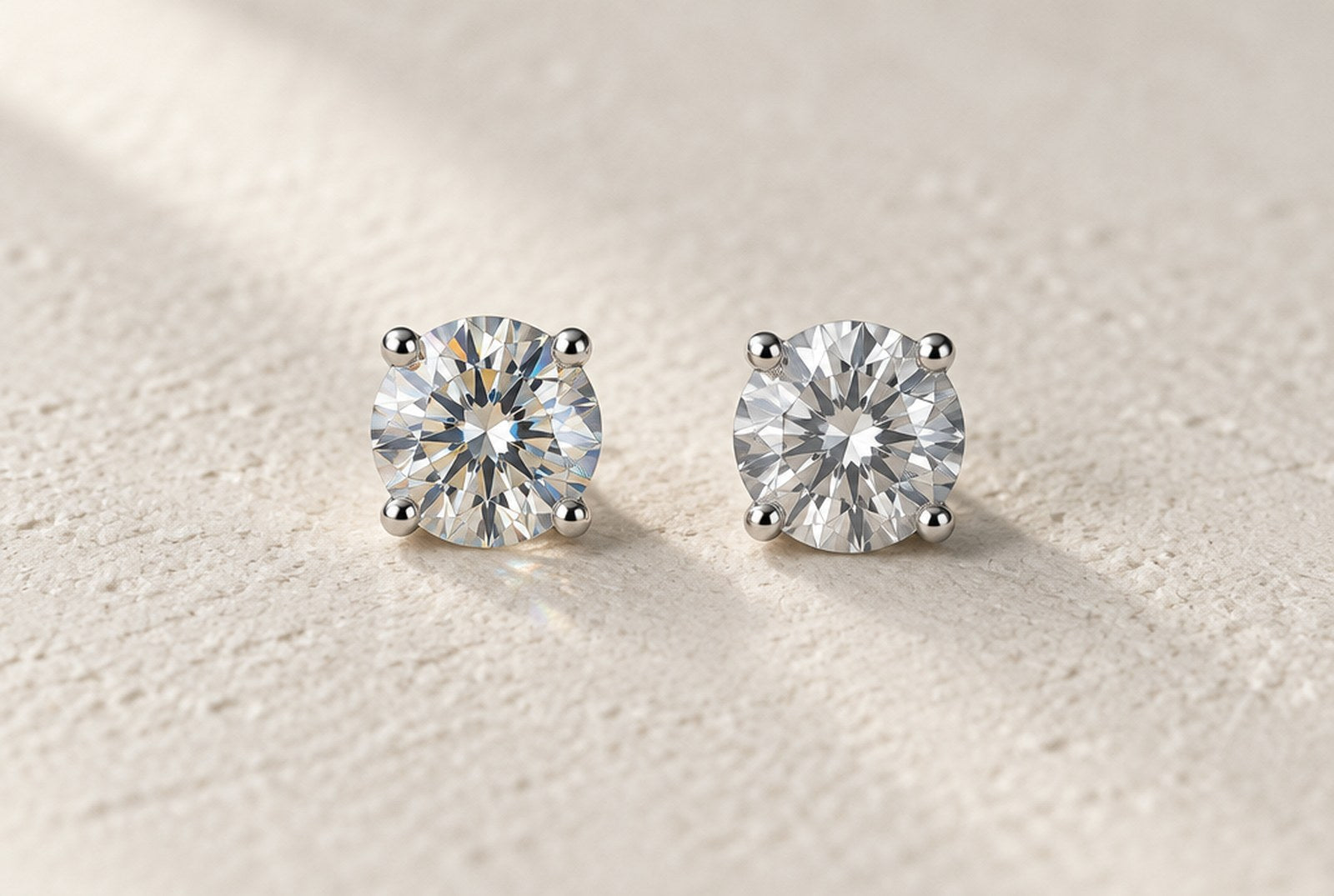
What the two stones actually are
Moissanite is silicon carbide, chemical formula SiC. It was first identified in meteorite material by the French chemist Henri Moissan, who initially mistook the crystals for diamonds and only confirmed them as silicon carbide in 1904. Natural moissanite is vanishingly rare, so every moissanite in jewelry today is grown in a lab. We told that story in full in the space gem origin story and covered how the growing process works in how moissanite is made.
White sapphire is corundum, aluminum oxide, formula Al2O3. It is the same mineral as a blue sapphire or a ruby. Pure corundum is colorless; the familiar colors come from trace elements. So "white sapphire" is not a separate gem species, it is sapphire with the color left out. It exists both as a mined stone and as a lab-created one, grown by flame fusion, a process that has been commercial since the early 1900s and is part of why lab white sapphire is so inexpensive.
Neither stone is a diamond, and neither should be sold as one. Moissanite is its own gemstone, with properties that beat diamond on some measures and not on others, as we set out in moissanite vs diamond.
Hardness: moissanite 9.25, white sapphire 9
On the Mohs scale of scratch resistance, moissanite sits at 9.25 and sapphire at 9. Diamond is 10. Both stones are therefore in the small group of gems hard enough to wear daily without babying them.
Here is the honest part: for earrings, this difference barely matters. The Mohs gap between 9 and 9.25 is real but small, and earrings do not take the abuse a ring does. A ring gets dragged across desks, door handles, gym equipment and car keys. A pair of studs sits on your earlobe doing nothing. Either stone will outlast the setting it is mounted in.
If you are choosing between these two for a ring, take the 9.25. If you are choosing for studs, hardness is not your deciding factor, and anyone telling you it is has not thought about where earrings live. What does matter for everyday wear is covered in can you wear moissanite every day.
Brilliance and fire: this is the real gap
This is where the two stones separate, and it is not close.
Brilliance comes down largely to refractive index, which is how strongly a material bends light. The higher the number, the more light gets turned around inside the stone and sent back to your eye instead of passing straight through.
- Moissanite: about 2.65 to 2.69. Higher than diamond.
- Diamond: about 2.42.
- Cubic zirconia: about 2.15 to 2.18.
- White sapphire: about 1.76 to 1.78. The lowest of the four by a wide margin.
Then there is fire, the splitting of white light into spectral colors. Moissanite's dispersion is 0.104, which is high enough that in direct light you see distinct rainbow flashes rather than only white sparkle. White sapphire shows very little fire by comparison. Its sparkle is softer, whiter and more subdued.
Put plainly: a white sapphire stud reads as a clean, glassy, pale stone. A moissanite stud reads as a stone that is clearly doing something. Which one you want is taste. But if you are buying earrings because you want them noticed, the lower refractive index is working against you.
This also explains the complaint you see repeatedly from white sapphire owners: the stones look flat in indoor light. A stone with less light return has less to work with when the light is poor. Moissanite's fire is the opposite problem for some people, which is worth knowing before you buy. We weighed that against the other alternatives in moissanite vs cubic zirconia and moissanite vs lab-grown diamond.
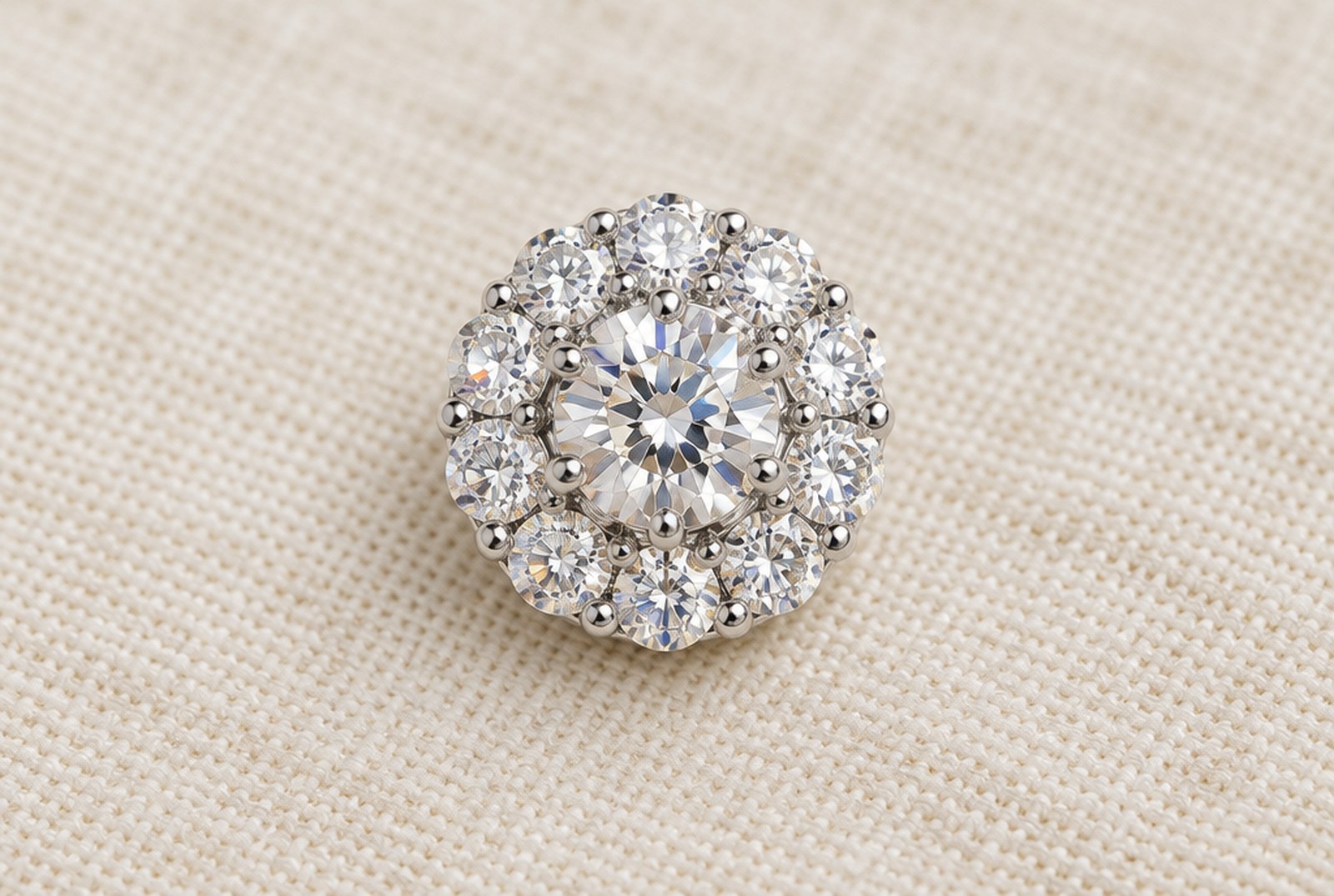
Color: "colorless" is doing some work in both cases
Mined white sapphires are frequently not fully colorless. Faint gray, blue or yellowish tints are common, and because the stone returns less light overall, a tint has less sparkle to hide behind. Lab-created white sapphire is cleaner and more consistent on color, for a fraction of the price.
Moissanite is graded on a color scale borrowed from diamond, and quality varies by supplier. Older or cheaper material can show a warm or greenish cast in certain light. Current colorless-grade moissanite does not, which is why the grade is worth checking rather than assuming. Our pieces use VVS-grade lab-grown stones, and what VVS moissanite actually means explains what those letters are and are not promising.
For earrings specifically, color matters less than it does for a ring. A stone on your ear is seen from two or three feet away by someone looking at your face, not through a loupe. Clarity and color grades sell stones; from across a table, size and light return are what you actually see.
Does white sapphire get cloudy over time?
You will read this claim constantly, and it deserves an accurate answer rather than a convenient one.
White sapphire does not chemically degrade or go permanently cloudy. Corundum is chemically stable and extremely hard. A white sapphire you buy today will be the same stone in twenty years.
What is true is that white sapphire looks dull faster when it is dirty. Skin oil, soap film and hairspray build up on any gemstone, and that film scatters light. On a high refractive index stone like moissanite there is enough light return to punch through a bit of grime. On a low refractive index stone there is not much to spare, so the same thin film reads as cloudy. The stone has not changed; the surface has.
So the honest version is: both stones need cleaning, and white sapphire is less forgiving when you skip it. Neither one "clouds up." We wrote the same correction about moissanite in does moissanite get cloudy, and the actual method is in how to clean moissanite jewelry at home.
Price
Lab-created white sapphire is the cheapest stone discussed here, often dramatically so, because flame fusion has been producing it cheaply for over a century. Mined white sapphire is a different market and can cost more than moissanite, depending on size and quality.
Moissanite sits in between: far below diamond, generally above lab white sapphire, and priced by grade rather than by rarity. If you want to understand why the number is what it is, why moissanite is so cheap breaks down the economics.
One thing worth saying about any gemstone earring under a few hundred dollars: the metal usually tells you more about the piece than the stone does. A cheap stone in genuine .925 sterling silver with a well-made screw-back post is a better purchase than a better stone in plated base metal that will turn your ear green in a month. What .925 sterling silver actually means is the short version of why.
Side by side
| Moissanite | White sapphire | |
|---|---|---|
| Material | Silicon carbide (SiC) | Corundum (Al2O3) |
| Mohs hardness | 9.25 | 9 |
| Refractive index | 2.65 to 2.69 | 1.76 to 1.78 |
| Fire (dispersion) | 0.104, high | Very low |
| Look | Bright, rainbow flashes | Soft, white, glassy |
| Performance in dim light | Holds sparkle well | Noticeably flatter |
| Shows surface dirt | Less | More |
| Typical price, lab-grown | Mid | Lowest |
| Best for | Being seen | Being subtle |
So which should you buy for earrings?
Buy moissanite if
You want the earrings to be visible. You wear studs as your main piece of jewelry rather than as a background detail. You are buying in the $100 to $250 range, where moissanite in sterling silver is the strongest thing available. Or you are buying a gift and want something that reads as a real purchase at a glance.
Buy white sapphire if
You specifically want a stone that does not sparkle much. Some people want the shape of a gemstone stud without the attention, particularly for work in conservative environments, and white sapphire delivers exactly that. It is also the right answer if you want the largest possible stone for the smallest possible spend and you do not care how it performs.
Buy neither if
You are shopping purely on the word "sapphire" because it sounds more legitimate than "moissanite." That is a marketing instinct, not a buying reason, and it will get you a duller stone for no gain.
Frequently asked questions
Is moissanite better than white sapphire?
On measurable properties, yes. Moissanite is harder (9.25 versus 9), has a much higher refractive index (around 2.65 versus around 1.76) and far more fire. White sapphire is better only if you actively prefer a subdued, low-sparkle stone or you are buying on lowest possible price.
Which sparkles more, moissanite or white sapphire?
Moissanite, by a wide margin. Its refractive index is roughly 2.65 to 2.69 against white sapphire's 1.76 to 1.78, so substantially more light is returned to the eye. Moissanite also has high dispersion, which produces visible rainbow flashes that white sapphire does not produce.
Is white sapphire harder than moissanite?
No. Sapphire is 9 on the Mohs scale and moissanite is 9.25, so moissanite is slightly harder. Both are hard enough for daily wear, and for stud earrings the difference is not practically meaningful.
Will people be able to tell the difference?
At conversational distance, most people will not identify either stone by name, but they will notice that one sparkles more. Moissanite is also distinguishable from diamond by a trained eye because it is doubly refractive, and we covered what that means for testing in does moissanite pass a diamond tester.
Does white sapphire need more cleaning than moissanite?
In practice yes, if you want it to look its best. Both stones collect the same skin oil and product film, but white sapphire returns less light, so that film shows as dullness much sooner. Neither stone is permanently damaged by it.
Is white sapphire a good substitute for a diamond in earrings?
It is a durable and inexpensive one, but not a visually convincing one, because the sparkle is clearly different. If what you want is a stone that performs like a diamond in a pair of studs, moissanite is the closer match on light return, while being honest about being its own gemstone.
If you want the stone that shows up
Everything we sell uses lab-grown moissanite set in genuine .925 sterling silver, with screw-back posts on the studs. Three places to start:
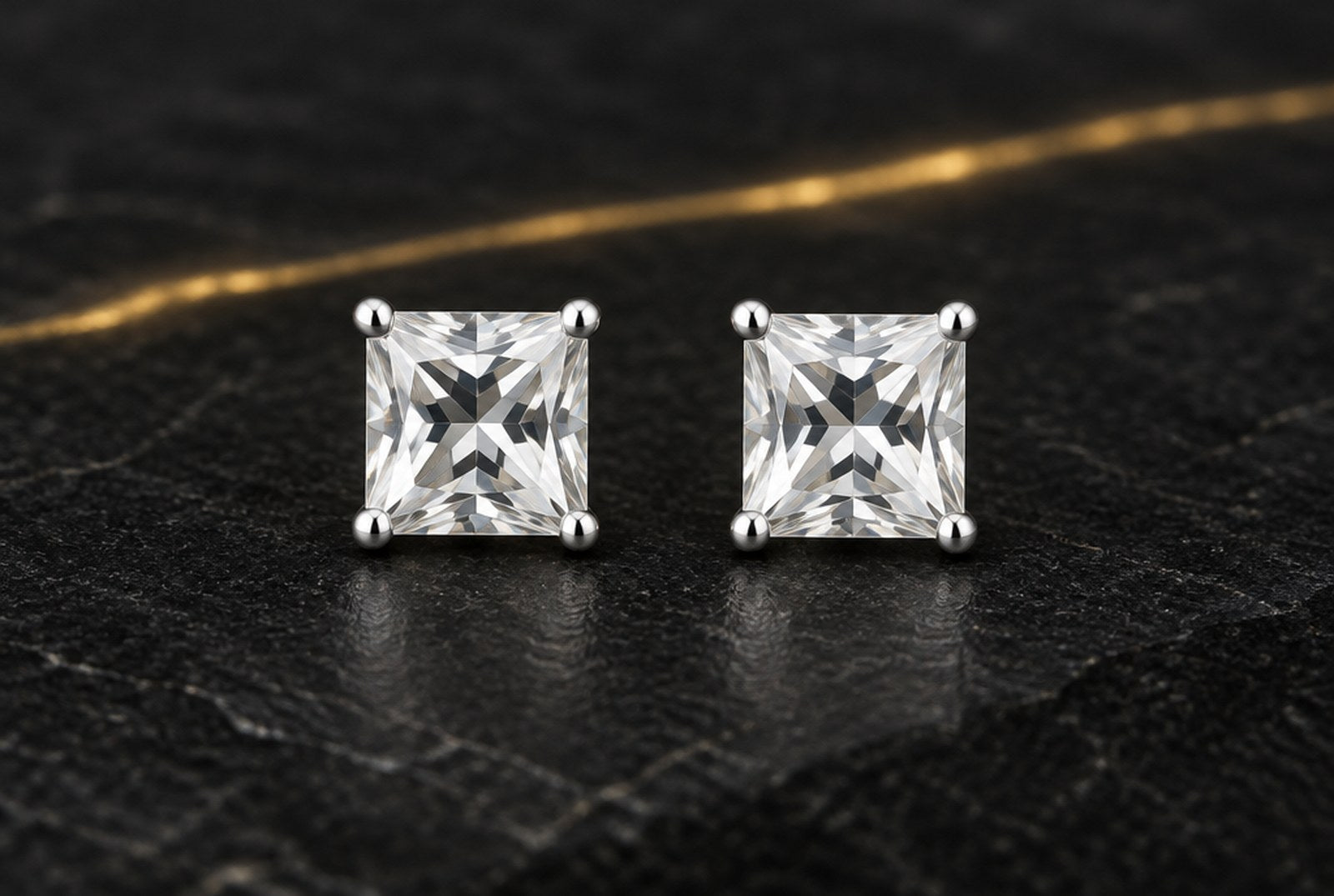
- Luxe Princess Cut VVS Lab Stone Earrings at $140. One square stone per ear in four prongs. The cleanest, most formal option we make.
- 9mm Luxurious Cluster Earrings at $140 in silver or gold finish. The widest visible face at this price.
- Timeless Heart Pavé Earrings at $120 in silver or rose gold. The safest specific choice if you are buying for someone else.
If you are not sure which shape or setting suits you, cluster, halo, pavé or single stone settles the setting in a couple of minutes and the two-minute earring size method settles the size. The moissanite earrings buying guide covers the whole decision in one place, and screw backs vs push backs explains the one detail most stores never mention.
Or just browse the full moissanite earrings collection and see the stones for yourself.