

Home / Jamilah Jewels Blog | Moissanite, Jewelry Guides and Buying Advice / Why Is Moissanite So Cheap? The Honest Economics
Why Is Moissanite So Cheap? The Honest Economics
August 7, 2026

Moissanite costs a fraction of what a diamond costs, and that gap is large enough to make people suspicious. If a stone looks like this and lasts like this, why is it so cheap?
The short answer: moissanite is not scarce, and nothing about the way it reaches you is built to keep it scarce. Jewelry moissanite is grown in a laboratory from two of the most common elements on Earth, a producer can decide to grow more of it, and it travels a much shorter path from furnace to finished piece than a mined stone does. Low price here reflects abundant supply and a short supply chain. It does not reflect a soft, fragile, or short-lived stone.
Here is what actually sets the price, what the low number does not mean, and why a finished piece still costs real money even when the stone in it does not.
What you are actually buying
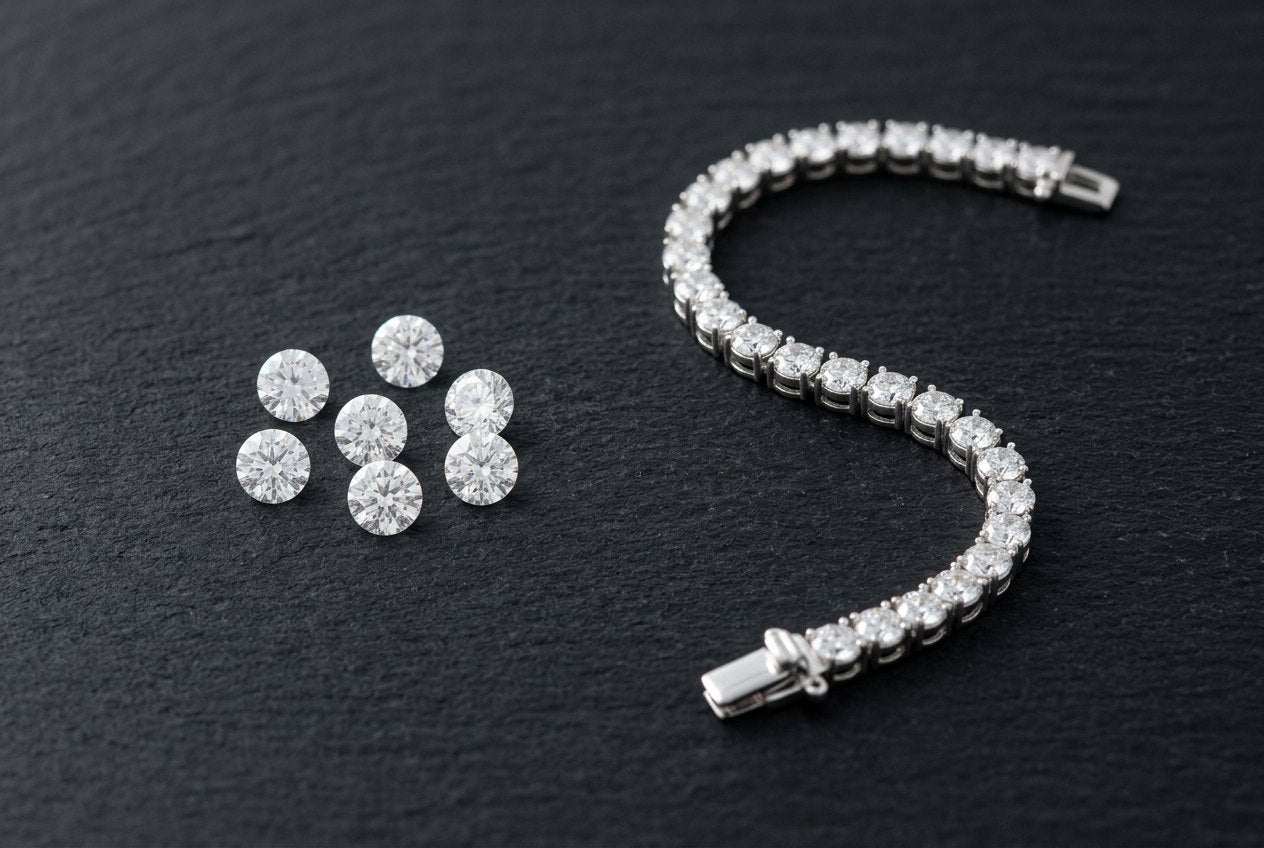
Every moissanite you can buy as jewelry, including every stone we set, is silicon carbide grown in a laboratory. Natural moissanite exists, but it turns up as microscopic grains in meteorite fragments and a handful of rare terrestrial deposits, far too small and far too scarce to cut into anything wearable. We covered that story in full in where moissanite comes from.
The important part for pricing is what silicon carbide is. Industrially, it has been made since the 1890s by baking petroleum coke and quartz sand together at extreme heat, and it is produced in enormous volume for abrasives, ceramics, and semiconductors. The raw ingredients are sand and carbon. They are not the expensive part of anything.
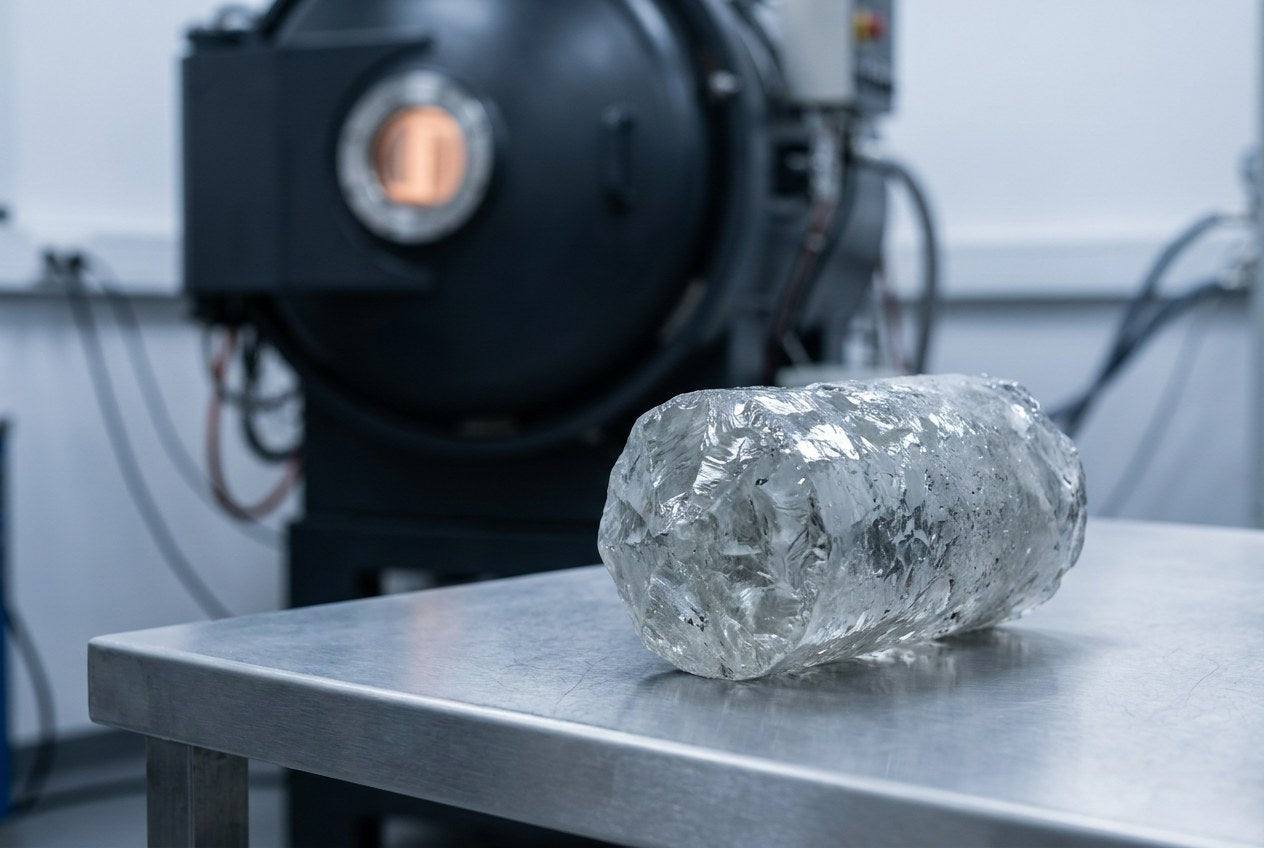
Gem-quality moissanite is a much harder problem than abrasive grit. Growing a single crystal large enough, clear enough, and colorless enough to cut into a wearable stone takes a controlled high-temperature growth process, days of furnace time, and a real reject rate. That is why a large, perfectly colorless moissanite still costs more than a small one. It is also why the price rises far more gently with size than a diamond's does. The constraint is furnace capacity, not geology.
Five reasons moissanite costs less than a diamond
1. Supply is a decision, not a discovery
A diamond has to be found. That means exploration, a mine, and a finite deposit that eventually runs out. If demand doubles, the industry cannot simply produce twice as many one-carat stones next quarter.
Moissanite has no such limit. If demand doubles, a producer adds furnaces. Everything downstream of that difference follows from it: no scarcity, no scarcity pricing.
2. There is no rarity premium built into the price
A large part of a natural diamond's retail price is not the cost of producing it. It is the value the market places on the fact that there are not many of them, reinforced by a century of advertising that made the diamond the default engagement stone. That premium is real, and people pay it knowingly for reasons that are often sentimental rather than material.
Moissanite carries none of it. You are paying roughly what it costs to grow, cut, and set the stone, plus the retailer's margin. Take that premium away and the number drops sharply, even though the stone in your hand is harder than almost anything else you could wear and throws more fire than a diamond does.
3. The patents expired, and competition did the rest
Gem-quality moissanite reached the market in 1998 through a single company, Charles & Colvard, which held the patents on the growth process. For roughly the first fifteen years, one producer set the price for the whole category, and moissanite was not especially cheap.
Those core patents expired in the mid-2010s. Other manufacturers entered, output climbed, cutting quality improved, and prices fell across the board. Most of what people now think of as "moissanite pricing" dates from after that point. The stone did not get worse. The market got competitive.
4. The path from furnace to finger is short
A mined diamond typically passes through a mine, a sorting house, a cutting and polishing operation, one or more wholesalers, a dealer, and finally a retailer. Each stage adds handling, insurance, financing, and margin. By the time a stone reaches a display case, a meaningful share of its price is the journey rather than the stone.
Moissanite skips most of that. It is grown, cut, and sold on to a jeweler who sets it. Brands that sell direct, as we do, cut out another layer. Fewer hands, fewer margins, lower price.
5. Stones are not individually certified
Fine diamonds are usually graded one by one by an independent laboratory, and that report costs money and time per stone. Moissanite is generally not sold that way. Because the growth process is controlled, producers make stones to a consistent specification and describe them by that specification rather than paying for an individual report.
Worth being straight about this, because it cuts both ways: when you see VVS clarity and D-color on a moissanite listing, including ours, that is a manufacturer's description of the grade the stone was grown to, not a third-party certificate. We explain what those terms mean and do not mean in what VVS moissanite actually is.
What "cheap" does not mean
This is the part the price tag genuinely does mislead people about. Low cost and low quality are not the same thing here, because the low cost comes from supply rather than from the material.
It does not mean soft
Moissanite sits at 9.25 on the Mohs scale. Diamond is a 10, and nothing else in normal life comes close. Sapphire is a 9, quartz, which is what most household dust is made of, is a 7. In practice that means a moissanite stone resists everyday scratching the way a much more expensive stone does. Cubic zirconia, by comparison, sits around 8 to 8.5 and abrades visibly with wear. We ran that comparison out over a year of wear in moissanite vs cubic zirconia.
It does not mean it clouds or fades
Moissanite does not change chemically with wear. What people read as clouding is almost always a film of skin oil, lotion, and soap residue sitting on the pavilion facets, which is why it comes back with a soft brush and warm soapy water. The full explanation is in does moissanite get cloudy, and the routine itself is in how to clean moissanite at home.
It does not mean it is cubic zirconia by another name
They are different materials, not two grades of the same one. Silicon carbide is harder, denser in feel, and disperses light more strongly. A jeweler can tell them apart quickly, and so can a diamond tester, for reasons we set out in does moissanite pass a diamond tester.
It does not mean it is a diamond
Moissanite is not a diamond and we will never describe it as one. It is a different mineral with different optical properties, and to some eyes the extra fire is a giveaway. If a stone that is chemically and optically a diamond is what you want, lab-grown diamonds have fallen a long way in price and are the honest comparison to run. The full side-by-side sits in moissanite vs diamond, including realistic price ranges for each.
Why the finished piece is not as cheap as the stone
Here is where the question usually goes next. If the stone is inexpensive, why is a bracelet three hundred and fifty dollars rather than thirty-five?
Because after a certain price point, the stone stops being the expensive part. What you are paying for is the metal, the number of stones, and the hours of setting work.
| Piece | Price | Where the money goes |
|---|---|---|
| Stud earrings | $140 | Two set stones, solid .925 posts and backs |
| Tennis bracelet | $350 | Dozens of set stones across 7 or 8 inches |
| Tennis chain | $500 | Far more stones across 18 to 22 inches |
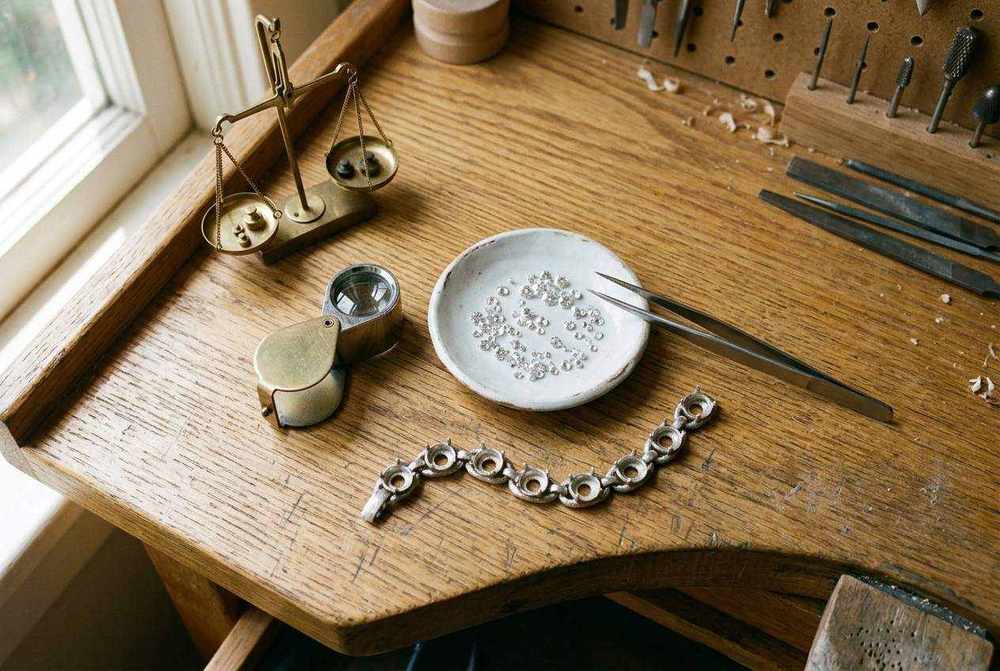
Every piece we make is built on solid .925 sterling silver, including the posts and backs on our earrings, which is a place a lot of brands quietly economize. Gold and rose gold colorways are plated over that same solid silver base rather than over brass. And each stone is set by hand, one at a time, with its own prongs. A tennis bracelet is not one setting job. It is dozens of them in a row, and every one has to be even.
That is the real reason the price of a finished piece scales with the piece rather than with the stone. A princess-cut stud at $140 and a 4mm tennis bracelet at $350 use the same grade of stone. The difference between them is metal and labor. If you want the full breakdown of how that works on bespoke work, we set it out in how custom moissanite jewelry actually works.
What the savings actually buy you
Three sensible things to do with the difference, and none of them is "buy the cheapest thing available."
- Size. The same budget buys a visibly larger stone. This is why moissanite dominates statement pieces: a 12mm cluster earring is a reasonable purchase in moissanite and an unreasonable one in diamond. Compare the two sizes in 9mm vs 12mm cluster earrings.
- Build quality. Put the difference into the piece instead of the stone. Solid sterling rather than plated brass, hand-set prongs rather than glued stones, a clasp that will still work in three years.
- Wearability. A stone you are not afraid of is a stone you actually wear. Most fine jewelry sits in a drawer because losing it would be a disaster. That calculation changes completely at these prices, which is the point of can you wear moissanite every day.
So is it worth buying?
If you want a stone that looks brilliant, survives daily wear, and costs a fraction of the alternative, yes, and the reason is boring rather than suspicious: nobody has to find it first.
If you specifically want a diamond, for the resale market, for the certificate, or because the material itself matters to you, then moissanite is not a substitute and no price argument will make it one. Be honest with yourself about which of those two people you are, and the decision gets easy.
One thing worth saying plainly: neither stone is an investment. Jewelry is bought at retail and sold into a wholesale market, and that gap is unforgiving regardless of what is set in it. If you are buying something to wear and keep, moissanite is the more sensible use of the money. If you are buying an asset, jewelry is the wrong asset.
Where to start
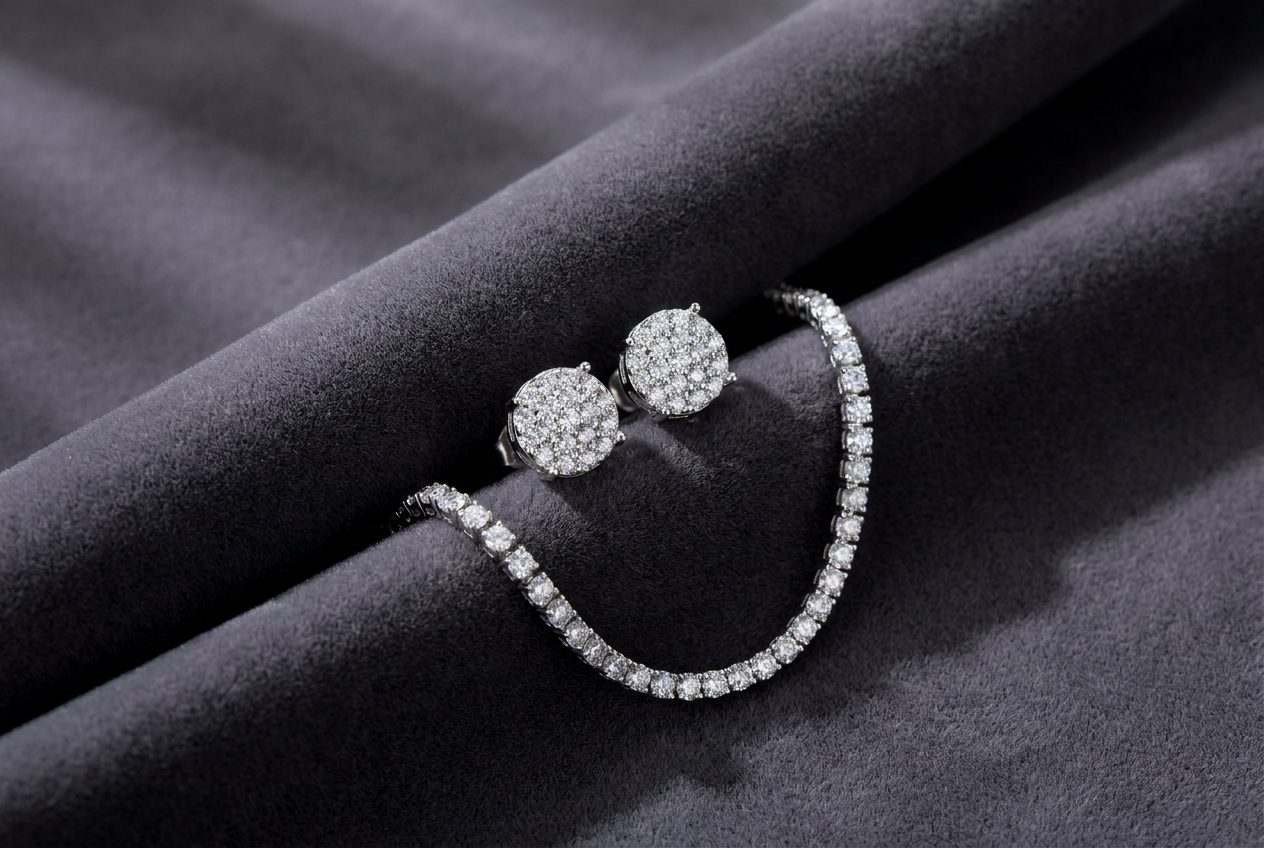
If this is your first moissanite piece, start small and see how it wears. Our Luxe Princess Cut studs are $140 and the 9mm cluster earrings start at the same price. The 4mm tennis bracelet at $350 is the piece most people buy first when they want something with presence.
Browse the full range across earrings, bracelets, chains, rings and pendants, or see what sells most in best sellers. If you are shopping to a budget, our picks under $200 is the shortcut.
Every piece is covered by our Lifetime Guarantee, which includes stone loss, prong and setting failure, clasp failure, and re-plating when normal wear takes the finish off a gold colorway. US shipping is free and fully insured, and returns are open for 30 days on unworn pieces in original packaging, with return shipping covered on approved returns. Custom and sale items are final sale. The details are in our FAQ.
Frequently asked questions
Why is moissanite so cheap compared to diamonds?
Because it is grown rather than mined. Supply can be increased to meet demand, so there is no scarcity premium in the price, and the stone travels through far fewer hands between the furnace and the finished piece. The low price reflects abundant supply, not poor quality.
Is cheap moissanite lower quality?
Not automatically, but price differences within moissanite are real. Larger, more colorless, better-cut stones cost more because they take more furnace time and have a higher reject rate. Cut quality is where the visible difference usually sits, not clarity. A poorly cut stone looks dull no matter what grade the listing claims.
Is moissanite a real gemstone or is it fake?
It is a real gemstone. Moissanite is silicon carbide, a genuine mineral first identified in a meteorite crater in 1893. The stones used in jewelry are lab-grown rather than mined, which makes them lab-created, not fake. It is not a diamond and should never be sold as one.
Will moissanite hold its value?
No, and neither will a diamond in any way that matters to a normal buyer. Jewelry sells into a wholesale market at a steep discount to retail. Buy it to wear, not as a store of value.
Why did moissanite get cheaper over the last ten years?
The core patents on the growth process expired in the mid-2010s. Additional manufacturers entered the market, production capacity rose, and competition pushed prices down while cutting quality improved.
Is moissanite harder than cubic zirconia?
Yes, and by enough to matter. Moissanite is 9.25 on the Mohs scale, cubic zirconia is roughly 8 to 8.5. That difference shows up as visible surface abrasion on cubic zirconia after a year or so of daily wear, while moissanite stays sharp.
If moissanite is cheap, why does a bracelet cost $350?
Because the stone is the least expensive component. You are paying for solid .925 sterling silver, dozens of individual stones, and the hand-setting labor to mount each one in its own prongs. The stone stops being the cost driver very quickly.
Does cheaper moissanite sparkle less?
Sparkle comes mostly from cut, not from price. A well-cut moissanite of any size disperses light strongly, and moissanite has higher dispersion than diamond, which is the extra colored fire people notice. A badly cut stone leaks light and looks flat regardless of what it cost.