

Home / Jamilah Jewels Blog | Moissanite, Jewelry Guides and Buying Advice / Screw Backs vs Push Backs: Which Earring Backing Is Safer?
Screw Backs vs Push Backs: Which Earring Backing Is Safer?
August 10, 2026

Screw backs are the safer earring backing. The threaded post physically cannot slide out of your ear, while a push back holds on by friction alone and that grip weakens with wear. If losing one stud would genuinely upset you, buy screw backs.
That said, "safer" is not the only thing that matters. Push backs go on in two seconds and screw backs do not. Below is how each mechanism actually works, when the convenience is worth the risk, and what to check before you buy a pair of studs you plan to wear every day.
How each earring backing actually works
The difference is not the little piece of metal on the back. It is the post.
Push backs, also called friction backs or butterflies
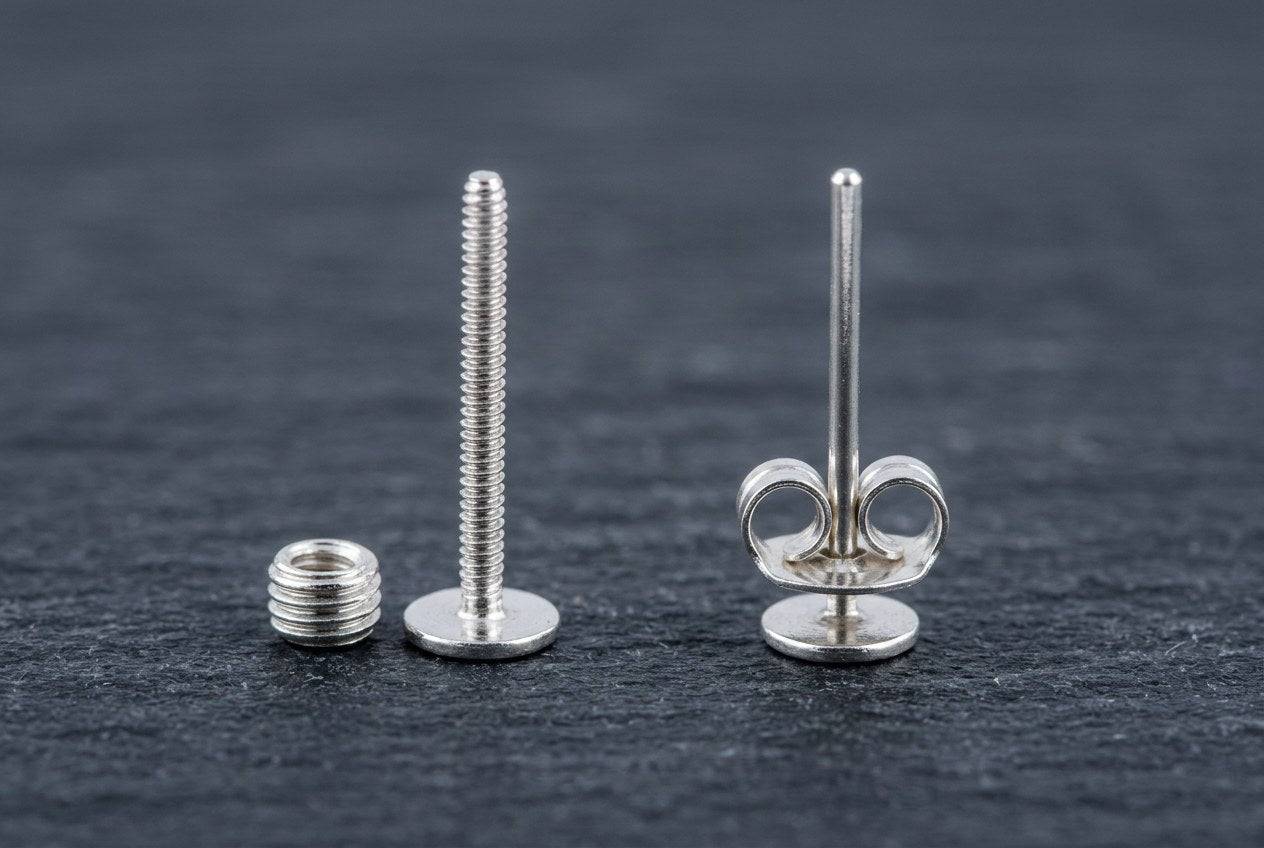
A push back earring has a smooth, straight post. The backing is a small piece of metal, usually shaped like a butterfly or a flat disc, with a tiny pinched channel through the middle. You push the post through that channel and the metal grips it by tension. Nothing locks. The only thing holding your earring on is how tightly that channel squeezes the post.
That works well when the backing is new. Over months of being pushed on and pulled off, the metal springs open slightly and the grip softens. It is the same reason an old hair clip stops holding.
Screw backs
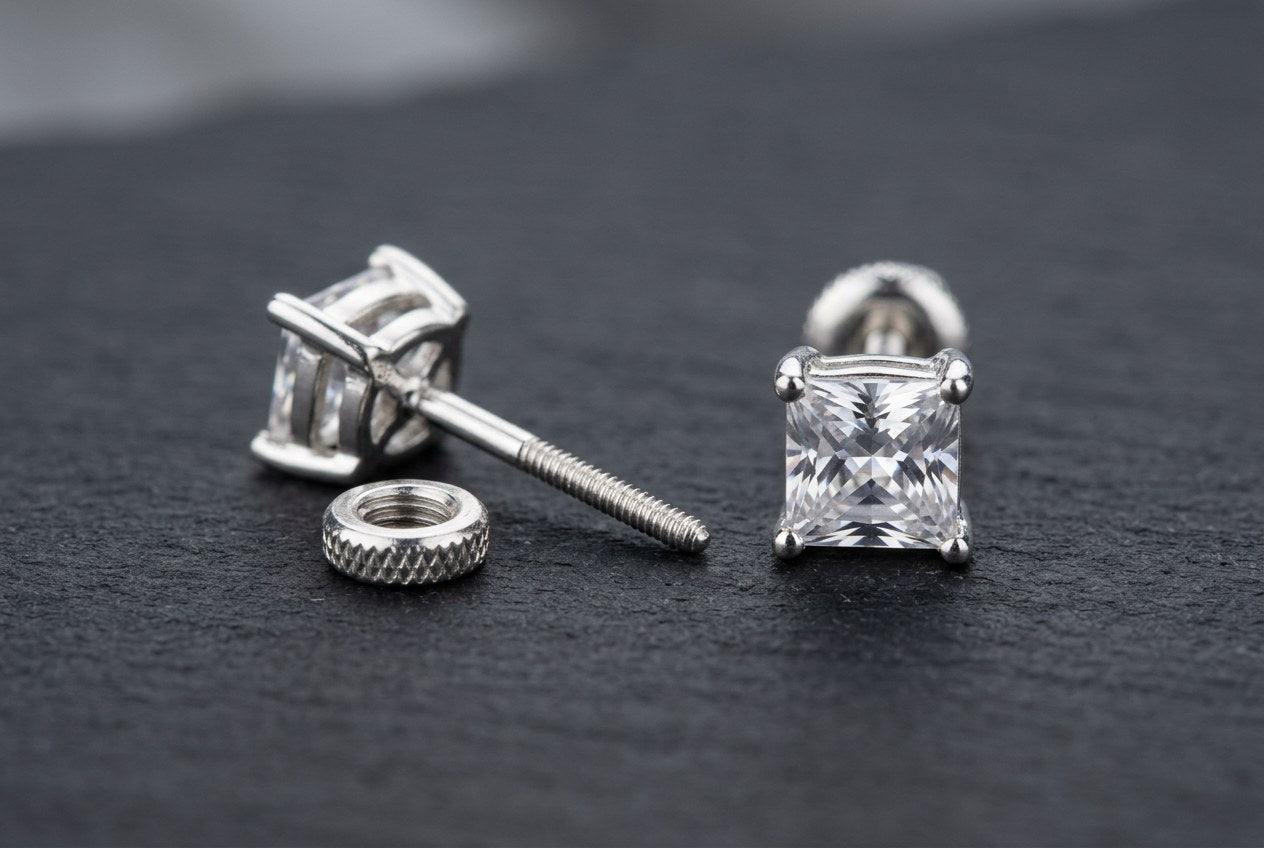
A screw back earring has a threaded post, like a miniature bolt. The backing is a small nut with matching threads inside. You turn it on, and it travels down the thread until it sits snug against your ear. To come off, it has to be unscrewed. Pulling on it does nothing.
This is why screw backs are the standard on higher value studs. A friction back can be dragged off by a sweater, a seatbelt, or a pillow. A screw back cannot, because there is no direction you can pull it that lets the nut cross the threads.
One thing people get wrong
The backing type is built into the earring. A screw back nut will not thread onto a smooth push back post, and a butterfly back will slip straight off a threaded post because the ridges give it nothing flat to grip. You cannot upgrade a pair of push backs to screw backs by buying different backs. You have to buy earrings that were made with threaded posts.
There is also a naming trap. Some clip-on earrings for unpierced ears are sold as "screw back" because a screw tightens the clip against the earlobe. Those are a completely different product. If a listing says screw back, check that it also says post or pierced.
Screw back vs push back at a glance
| Factor | Screw back | Push back |
|---|---|---|
| Security | Very high | Moderate |
| Post type | Threaded | Smooth |
| Speed on | Slow | Fast |
| Loosening | Rare | Common |
| Heavy studs | Yes | Risky |
| Best for | Daily wear | Quick swaps |
Why push backs loosen, and how to tell yours has
Three things wear a friction back out. The first is repetition: every time the backing goes on and off, the pinched channel opens a fraction. The second is snagging, which yanks the back sideways and bends it. The third is the post itself, which polishes smooth over time and gives the backing even less to bite into.
The test takes five seconds. Put the earring on, then tug the backing gently straight back, away from your ear. If it slides at all before it stops, the grip is going. A backing that has to be worked off is still doing its job.
You can squeeze a butterfly back very slightly closer together with your fingertips to restore some tension, and it will buy you time. It will not fix a post that has worn smooth, and squeezing too hard cracks the metal loop. Treat it as a repair, not a solution.
When a push back is genuinely the better choice
Screw backs win on security, but there are real cases where they are the wrong tool.
- Earrings you change constantly. If you swap studs to match an outfit every morning, threading four nuts before coffee gets old fast.
- Very small, very light studs. A tiny stone weighs almost nothing and puts almost no pull on the backing. The risk a screw back solves is smaller here.
- Second and third piercings placed close together. A screw back nut is thicker than a butterfly and needs room behind the lobe to turn.
- A freshly pierced ear. New piercings should stay in the jewelry your piercer fitted until they tell you otherwise. Ask them, not us.
Everywhere else, and particularly on a stud you plan to sleep, travel, and go to the gym in, the screw back is worth the extra ten seconds. If you want the full picture on wearing stones around the clock, we covered it in can you wear moissanite every day.
Stone size changes the math
The heavier the front of the earring, the harder it pulls on whatever is holding it. A 4mm stud and a 12mm cluster are not the same problem.
Weight does two things. It drags the post downward through the piercing, which angles the stud and puts sideways load on the backing. It also gives a snag more leverage. This is exactly why bigger studs are the ones that go missing, and why the size decision and the backing decision are really one decision. If you are still choosing between sizes, our 9mm vs 12mm cluster earrings guide and the two-minute earring sizing method both walk through it, and the princess-cut vs round studs comparison covers shape.
What Jamilah Jewels uses, and why
Our stud earrings are built with screw-back posts, and you can see it stated on the product pages across the earring collection. That was not a styling decision. Our studs are set with sizeable VVS moissanite, they are priced as pieces you keep, and a friction back is the wrong closure for either of those facts.
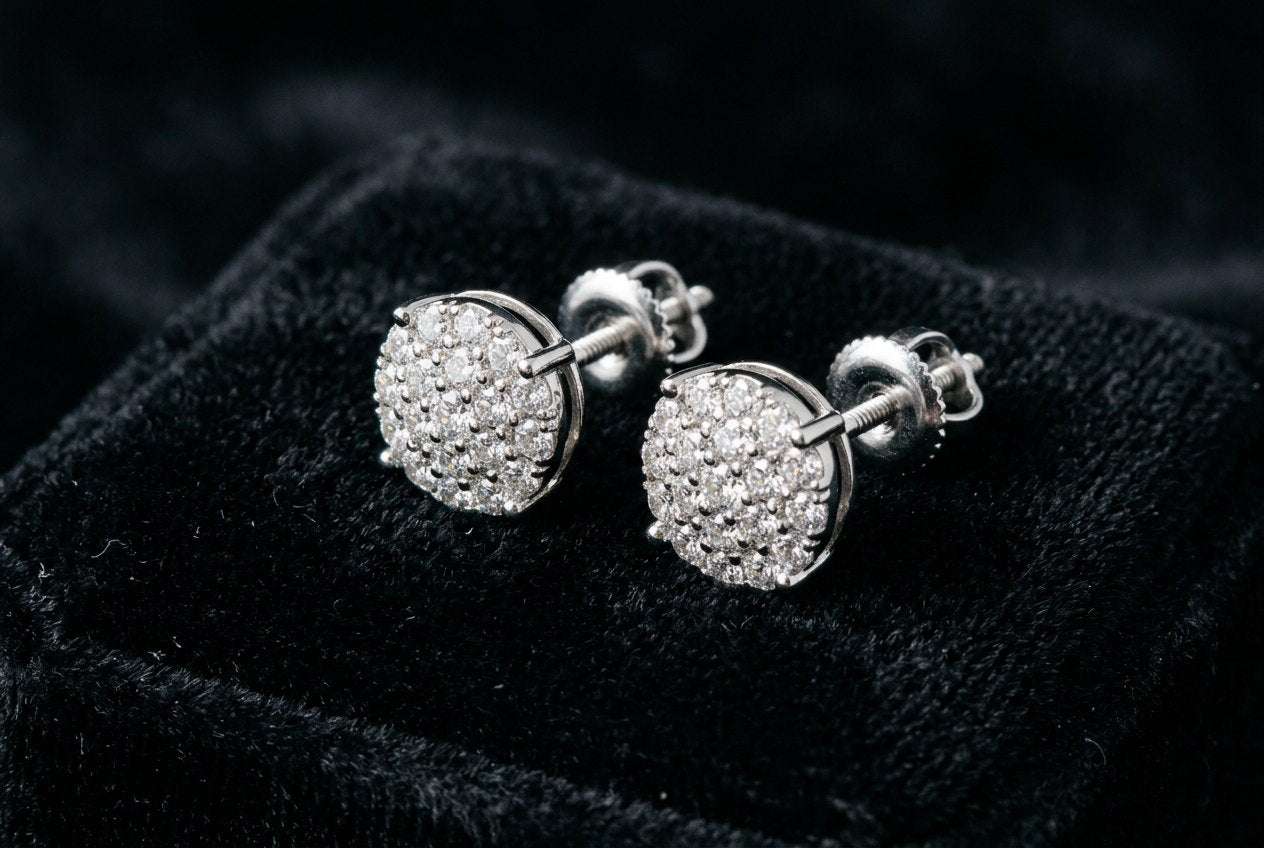
The detail that matters more than most people realize is what the backing is made of. Per our FAQ, every piece we make is built on solid .925 sterling silver, and that includes the posts and the backs. No brass, no plated base metal on the part that sits against your skin all day. Gold and rose gold colorways are plated over that same solid sterling base. If you want the reasoning behind the metal itself, read why we use .925 sterling silver.
A few pairs to look at, all screw-back:
- Luxe Princess Cut studs, $140. A single square-cut VVS stone, rhodium finished. The lightest screw-back option we make.
- 9mm cluster earrings, from $140 in silver and gold. The everyday iced-out stud.
- 12mm cluster earrings, from $170. Noticeably bigger, and the pair where a screw back earns its keep.
- Timeless Clover studs, $150, and the Heart Pavé studs, $120, if you want shape rather than a solitaire.
- Pink cluster studs, from $200, in rose gold-plated sterling silver.
- Radiant Marquise and Emerald Radiance Marquise, $200, plus the Hexaluxe and Crossed Icon studs at $130 to $150.
Prices and stock move, so check the product page. Our best sellers is a good shortcut if you want to see what people actually buy. And if those numbers look low for stones this size, that is a fair question with a real answer: we wrote it up in why moissanite is so cheap.
How to put screw-back earrings on without the fight
Most people who dislike screw backs are fighting the post instead of guiding it. The order below fixes that.
- Hold the stone between thumb and forefinger and find the piercing with the tip of the post before you push. Threaded posts are slightly blunter than smooth ones, so aim first.
- Push the post through with a gentle, straight motion. Do not twist it going in. Twisting the post inside the piercing is what makes screw backs feel unpleasant.
- Start the nut with your other hand and turn it clockwise. Give it a second to catch the first thread rather than forcing it.
- Stop when it is snug against the back of your lobe. Snug, not tight. Overtightening does not add security, it just presses the lobe and wears the threads.
- Do it over a table or a closed drain. The nut is small and it bounces.
Taking them off is the same in reverse: hold the front still, unscrew the back, and put the nut somewhere it cannot roll before you deal with the second ear.
How to stop losing earrings, whatever backing you have
- Earrings on last, off first. After your clothes and hair are done, before anything comes over your head. Most losses happen to a sweater, not to a backing.
- Check the tension weekly if you wear push backs. The five-second tug test above.
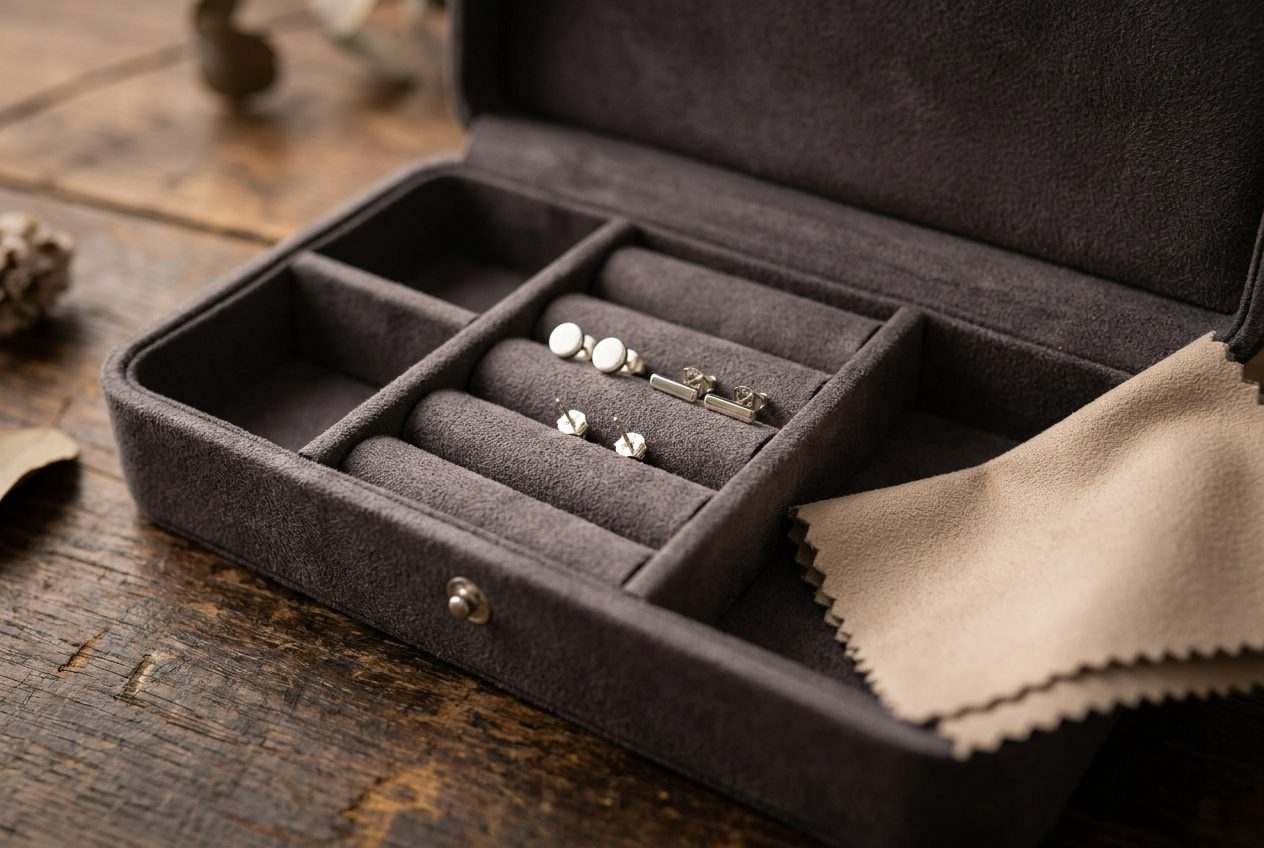
- Store them backed, in pairs. A slotted box or a pouch beats a dish. Loose backs on a nightstand are how a pair becomes a single.
- Take them off for the pool and the shower. Chlorine and shampoo residue do silver no favors, and wet fingers drop small metal. Our sterling silver care guide and cleaning guide cover the routine.
- Keep the spare backs. If a pair ships with an extra nut, that nut is worth more than it looks.
One thing worth knowing before you panic about a failed closure: our lifetime guarantee covers stone loss, setting or prong failure, and clasp failure. It does not cover an earring you lost. That is the honest line, and it is the reason we build the backing to not fail in the first place.
Frequently asked questions
Are screw back earrings really more secure than push backs?
Yes. A screw back nut travels along a threaded post and cannot slide off under a straight pull, so a snag on clothing or bedding will not remove it. A push back is held only by friction, and that friction weakens as the backing and post wear. Screw backs are the standard on higher value studs for this reason.
Can I put screw backs on my push back earrings?
No. Screw back nuts need a threaded post to grip, and push back earrings have smooth posts. The backing type is decided when the earring is manufactured. If you want screw backs, buy earrings made with threaded posts.
Do screw back earrings hurt?
They should not. Discomfort almost always comes from twisting the post while it is inside the piercing, or from screwing the nut down too tight. Push the post straight through first, then turn only the nut, and stop when it sits snug rather than pressed.
Are screw back earrings good for sleeping in?
They are the better of the two for it, because a pillow cannot drag the backing off. Whether to sleep in earrings at all is a separate question, and the more relevant risk is bending the post or the setting against the pillow rather than losing the stud.
Why do my push back earrings keep falling out?
The backing has lost tension, the post has polished smooth, or both. Pinching a butterfly back very slightly closed can restore some grip temporarily. If it keeps happening on a pair you care about, replace the earrings with screw backs rather than replacing the backs.
What are the earring backs made of?
On every Jamilah Jewels piece, the post and the backing are solid .925 sterling silver, the same metal as the rest of the earring. Gold and rose gold colorways are plated over that solid sterling base rather than built on a different metal.
Which backing is better for heavy or large studs?
Screw backs, clearly. A larger stone pulls harder on the closure and gives snags more leverage, which is exactly the situation a friction back handles worst. If you are buying a 12mm cluster or anything with real presence, the backing should be threaded.
Do all Jamilah Jewels earrings use screw backs?
Our stud earrings are built with screw-back posts. Each product page states the closure for that specific piece, so check the description if a detail matters to you, or contact us and we will confirm before you order.
The short version
Push backs are convenient and fine for light studs you change often. Screw backs are what you want on anything you would be upset to lose, which is most stones worth setting in sterling silver. The extra ten seconds is the whole price.
If you are new to the stone itself and still deciding whether it belongs in your ears at all, start with moissanite vs diamond.
Every stud we make is built that way, on solid .925 sterling silver posts and backs, set with VVS moissanite, and covered by our lifetime guarantee. Browse the earring collection and pick the size first, then the shape. The backing is already handled.