

Home / Jamilah Jewels Blog | Moissanite, Jewelry Guides and Buying Advice / Moissanite vs Lab-Grown Diamond: Which Should You Actually Buy?
Moissanite vs Lab-Grown Diamond: Which Should You Actually Buy?
July 29, 2026

Lab-grown diamonds have gotten dramatically cheaper over the past few years, which makes the moissanite question harder than it used to be. If both stones are lab-made and both cost a fraction of a mined diamond, why choose one over the other?
The short answer: a lab-grown diamond is a diamond — identical carbon crystal, 10 on the Mohs scale, and it certifies and tests as diamond. Moissanite is a completely different gemstone (silicon carbide) that throws noticeably more colorful fire and costs far less, especially in pieces with a lot of stones. If the diamond label and a grading report matter to you, buy the lab diamond. If you want maximum presence per dollar in something you'll wear constantly — cluster earrings, a tennis chain, a bold cocktail ring — moissanite wins on value, and it isn't a close contest.
Here's the full breakdown, including where we use each one.
What each stone actually is
Lab-grown diamond
Grown in a reactor instead of mined from the earth, using either HPHT (high pressure, high temperature) or CVD (chemical vapor deposition). The result is chemically and structurally identical to a mined diamond: pure crystallized carbon. It is not a simulant or an imitation. Labs like IGI and GIA grade it on the same 4Cs scale they use for mined stones.
Moissanite
Silicon carbide — a different mineral entirely. It does occur in nature, but only in vanishingly small quantities; it was first identified in fragments from a meteorite crater, which is where its "space gem" nickname comes from. Every moissanite used in jewelry today is lab-created. It has its own optical signature, and that's the point: it isn't trying to be a diamond. It's its own stone, with its own look.
Side by side: the specs that matter
| Property | Moissanite | Lab-grown diamond |
|---|---|---|
| Material | Silicon carbide (SiC) | Carbon (C) |
| Mohs hardness | 9.25 | 10 |
| Refractive index | 2.65–2.69 | 2.42 |
| Dispersion (fire) | 0.104 | 0.044 |
| On a diamond tester | Reads as moissanite on a dual tester | Reads as diamond |
| Grading reports | Graded by supplier (color and clarity) | IGI / GIA reports widely available |
| Cost for the same look | Lowest | Higher, and rises fast with stone count |
| Everyday durability | Excellent | Excellent |
Those two middle numbers — refractive index and dispersion — are where the visible difference lives.
Sparkle: a real, visible difference
A higher refractive index means more light gets bent and returned to your eye rather than passing through. At 2.65–2.69, moissanite bends light more than diamond's 2.42, so it reads brighter for the same cut quality.
Dispersion is the more dramatic one. It measures how strongly a stone splits white light into spectral colors — what jewelers call fire. Moissanite's 0.104 is more than double diamond's 0.044. In practice, under sunlight or spotlights, moissanite throws visible flashes of rainbow color. A diamond, lab-grown or mined, sparkles in a whiter, more restrained way with occasional color.
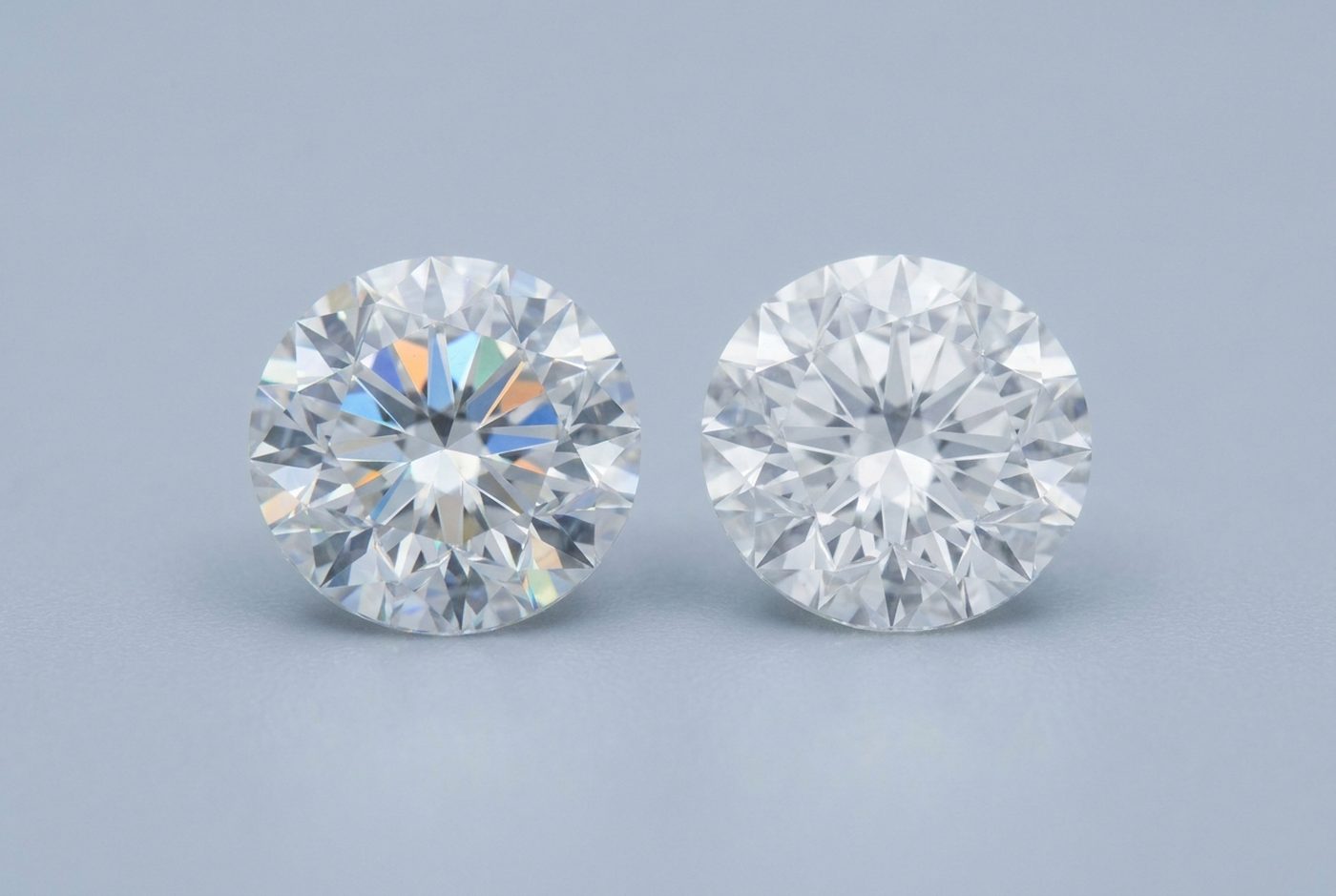
Which one looks better is genuinely a matter of taste, not fact. Heavy fire reads as iced-out and photographs beautifully, which is a large part of why moissanite dominates hip-hop and statement jewelry. Some people find that much color distracting in a classic solitaire and prefer the cleaner white flash of a diamond.
One practical note on scale: fire is much more visible in bigger stones and in pieces with many stones catching light from different angles. Below roughly half a carat, the difference is subtle. On a 9mm cluster earring or a fully set 4mm tennis chain, it's unmistakable.
Durability and everyday wear
Diamond is harder — 10 versus 9.25 — and that's a real difference on paper. In daily life it matters less than the numbers suggest. The main thing that scratches gemstones is ordinary household dust, which contains quartz at about 7 on the Mohs scale. Anything meaningfully above 8 shrugs that off. Both stones qualify comfortably.
Moissanite is also tougher than its hardness rating implies. It has high fracture toughness and no cleavage planes. Diamond, for all its hardness, does have cleavage directions and can chip if it takes a hard knock at exactly the wrong angle.
The honest reality for both: the stone is almost never what fails. Prongs loosen, silver tarnishes, clasps wear. Check your settings a couple of times a year and clean pieces properly — our moissanite cleaning guide covers the method, and if you've ever wondered whether the stone itself degrades, it doesn't.
Price in 2026: what actually changed
Lab-grown diamond prices have fallen hard. A one-carat lab diamond that retailed in the low thousands at the start of the decade now commonly sells loose for a few hundred dollars, as manufacturing capacity expanded and wholesale prices settled close to production cost. That's a genuine shift, and it does narrow the gap with moissanite at small sizes.
Where the gap has narrowed:
- A single modest center stone — say a half-carat to one-carat solitaire. Here it's worth comparing real prices rather than assuming moissanite is automatically cheaper.
Where the gap is still enormous:
- Larger center stones. Lab diamond pricing still climbs steeply with carat weight. Moissanite stays flat by comparison.
- Anything with a high stone count. Tennis chains, tennis bracelets, cluster earrings, pavé bands, grillz. A fully iced tennis chain in lab diamond runs into five figures. Ours is $500–550 in VVS moissanite.
- Statement scale. If the goal is presence — size, coverage, light return — moissanite gets you there for a fraction of the cost, every time.
So the rule of thumb is simple: the more stones and the more carat weight involved, the more decisively moissanite wins on value.
Will either one hold its value?
Worth being blunt here, because plenty of jewelry marketing isn't. Neither stone is a store of value. Lab-grown diamond resale has fallen along with retail pricing, and moissanite has essentially no secondary market at all. Buy either one because you want to wear it and enjoy it — not as an asset. If resale value is genuinely part of your decision, that conversation is about mined diamonds and precious metal weight, not about these two.
Will anyone be able to tell?
A lab diamond is a diamond, so it tests as diamond and certifies as diamond. There's nothing to detect.
Moissanite is different, and we're straightforward about it: a basic thermal diamond tester will often read moissanite as diamond, because the two conduct heat similarly. A dual tester that also measures electrical conductivity will correctly identify it as moissanite. We wrote a full explanation in does moissanite pass a diamond tester.
Visually, at conversational distance, most people won't distinguish a well-cut D-color VVS moissanite in a good setting from a diamond. Under bright light, someone who knows stones will notice the extra color flash. We never claim moissanite is a diamond, and you should be wary of any brand that does. (Cubic zirconia is a different story entirely — here's how it compares.)
Which we use, and where
Since this is the part that actually helps you buy, here's how it works at Jamilah Jewels:
Our ready-to-wear collection is VVS moissanite set in .925 sterling silver. That's a deliberate choice, not a compromise — for earrings, tennis chains, bracelets, pendants and everyday rings, stone count is high and moissanite delivers dramatically more piece for the money.
For custom commissions, we use whichever stone and metal the piece calls for, including lab diamonds and solid gold. The Custom 2 CT Radiant Cut Wedding Ring in our portfolio was built with a 2.01-carat lab diamond center in solid 14k gold, for a client who wanted exactly that. So if you want a lab diamond engagement ring, that's a custom conversation with us rather than a catalog purchase.
The practical mapping:
- Traditional engagement ring, grading report matters → lab diamond, custom-built
- Engagement ring, maximum size for the budget → moissanite (we made the full case in is moissanite good for an engagement ring)
- Statement earrings and cluster studs → moissanite, comfortably
- Tennis chains, tennis bracelets, iced pendants, grillz → moissanite, no real debate
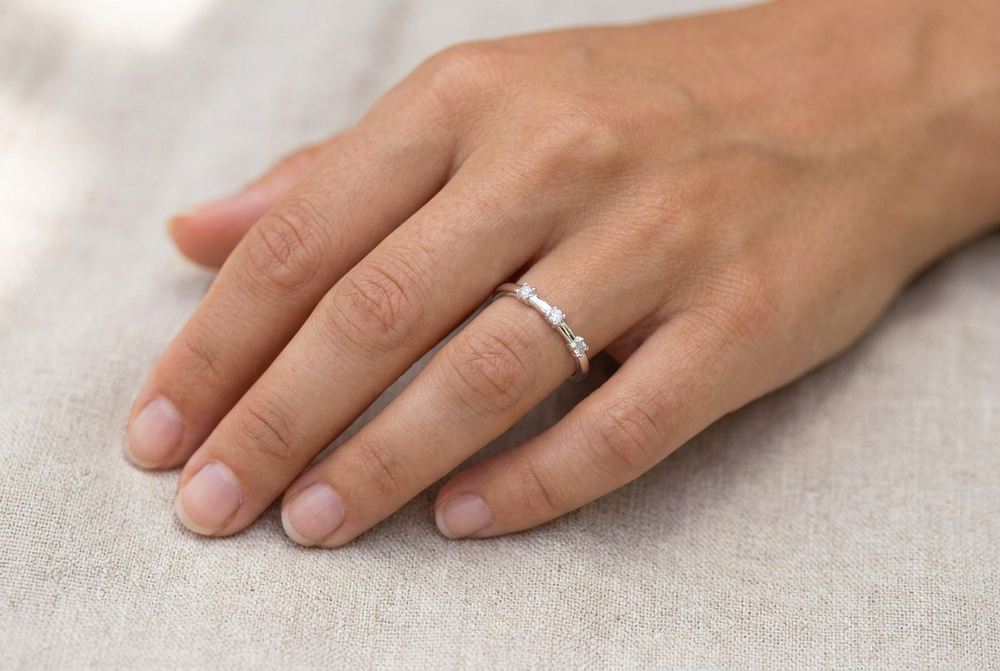
- Everyday band → either works; we'd say moissanite unless you specifically want the diamond label. The 'Grounded Soul' Minimalist Band is our pick at $300.
Frequently asked questions
Is moissanite fake?
No. It's a real mineral with its own gemological identity, lab-grown for jewelry use. It isn't a diamond and it isn't an imitation of one — it's a separate gemstone.
Is a lab-grown diamond a real diamond?
Yes. Chemically, physically and optically identical to a mined diamond. The only difference is where it formed.
Which one sparkles more?
Moissanite, measurably. Higher refractive index and more than double the dispersion. Whether you prefer that look is personal.
Now that lab diamonds are cheap, is moissanite still worth it?
For a single small stone, sometimes it's close — compare actual prices. For anything with multiple stones or real carat weight, moissanite still costs a small fraction of the lab diamond equivalent.
Will moissanite scratch or scuff over time?
At 9.25 on the Mohs scale, normal wear won't scratch the stone. The silver setting will need occasional polishing long before the stone shows anything.
Which is better for sensitive skin?
Neither stone causes reactions — it's the metal that matters. Our pieces are .925 sterling silver rather than nickel-heavy alloys, which is the relevant part.
The bottom line
Lab-grown diamonds and moissanite aren't really competing for the same job. A lab diamond gives you the diamond name, a grading report, and a whiter, more classical sparkle — worth paying for if those things matter to you, and increasingly affordable at smaller sizes. Moissanite gives you more fire, more size, and far more finished jewelry for the same money, which is why it's the right stone for anything meant to catch the light and be worn hard.
We build in both. Most people who come to us want presence and durability without the diamond premium, and for that, moissanite is the honest answer.
Browse the full Jamilah Jewels collection, or tell us about a custom piece if you have something specific in mind. Every order ships free and insured, with 30-day returns.