

Home / Jamilah Jewels Blog | Moissanite, Jewelry Guides and Buying Advice / Moissanite vs Diamond: What Nobody Tells You
Moissanite vs Diamond: What Nobody Tells You
March 13, 2026

Search “moissanite vs diamond” and you get two kinds of answers: jewelers who want to sell you a diamond, and moissanite brands who oversell their stone. Neither one gives you the full picture.
This guide tries to. We sell moissanite, so read us with that in mind — but everything below is checkable, and we will tell you plainly where a diamond is the better buy. By the end you will know which stone belongs on your hand.
The short answer
Moissanite bends and disperses more light than a diamond, so it reads brighter and throws noticeably more colored fire. At 9.25 on the Mohs scale it is hard enough to wear every day. And it costs a small fraction of a comparable natural diamond. What it is not is a diamond — it is a different mineral, and we will never tell you otherwise. A natural diamond still wins on hardness, on independent grading, and on social symbolism. For some buyers, those three things are the entire point.
Moissanite vs diamond at a glance
| Moissanite | Natural diamond | |
|---|---|---|
| Chemical makeup | Silicon carbide (SiC) | Carbon (C) |
| Brilliance (refractive index) | 2.65 – 2.69 | 2.42 |
| Fire (dispersion) | 0.104 | 0.044 |
| Hardness (Mohs) | 9.25 | 10 |
| Origin | Lab-created | Mined |
| Typical 1 ct loose stone | $200 – $450 | $4,000 – $12,000 |
What is moissanite, exactly?
Moissanite is a gemstone made of silicon carbide. It was identified in 1893 by the French chemist Henri Moissan, who later won a Nobel Prize, in rock fragments from a meteor crater in Arizona. That is where the “space gem” nickname comes from, and the full story is worth reading in our guide to where moissanite actually comes from.
Naturally occurring moissanite is vanishingly rare — far too rare to cut into jewelry at any scale. Every moissanite stone you can realistically buy, including every stone we set, is grown in a lab under controlled heat, using a process that takes weeks per crystal. That is not a shortcut or a compromise. It is simply the only way this mineral exists in usable sizes.
Is moissanite a real diamond?
No. Moissanite is a real gemstone, but it is not a diamond and it is not a “fake diamond” either — those are two different things. A diamond is crystallized carbon. Moissanite is silicon carbide. They are separate minerals with separate optical signatures, and any seller describing moissanite as a diamond is misrepresenting it. What moissanite does share with diamond is the visual outcome most people are actually shopping for: a hard, colorless, extremely bright stone.
Sparkle: does moissanite shine brighter than a diamond?
Yes, measurably. Brilliance comes down to refractive index — how sharply a stone bends light and throws it back at your eye. The higher the number, the more light comes back.
| Gemstone | Refractive index |
|---|---|
| Moissanite | 2.65 – 2.69 |
| Diamond | 2.42 |
The second number that matters is dispersion, or fire — how much a stone splits white light into colored flashes. Moissanite measures 0.104 against diamond’s 0.044, which is more than double. So moissanite is not simply a diamond look-alike that happens to be cheaper. Optically it does more.
What the extra fire actually looks like in person
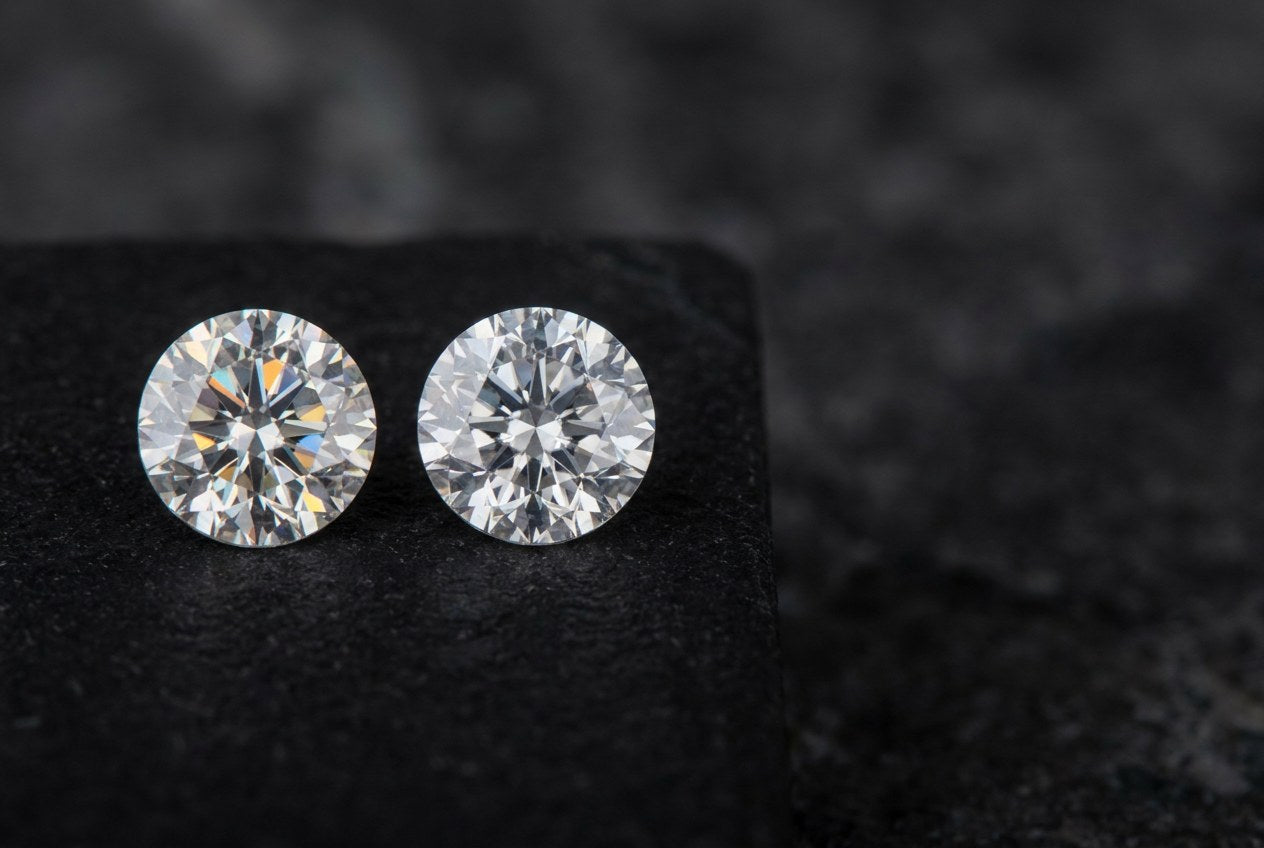
Under flat, diffused light — an overcast afternoon, most office ceilings — the two stones look very close. The difference shows up under point-source lighting: restaurant spots, stage and club lighting, phone flash. That is when moissanite starts throwing distinct rainbow flashes where a diamond returns whiter, more restrained light.
Whether you like that is genuinely a matter of taste. Some people want the extra color. Some find it reads less classic. Two practical notes: the effect is much more visible above roughly one carat, and it is muted in clusters and pavé work where many small stones share the light. If you want maximum drama, go bigger and rounder. If you want restraint, our moissanite cluster earrings and smaller settings deliver brightness without the light show. Cut shape changes it too, which we cover in our guide to moissanite ring cuts and hand shapes.
Hardness and durability: is moissanite stronger than a diamond?
A diamond is harder. It sits at 10 on the Mohs scale, the top of it. Moissanite sits at 9.25, which makes it the second hardest material commonly set in jewelry — above sapphire and ruby at 9, and far above the quartz and glass that make up most of the grit and dust your jewelry meets in a day.
The Mohs scale is a ranking, not a measurement, and the gaps between steps are not equal. What matters in practice is this: almost nothing you encounter in ordinary life is hard enough to scratch either stone. Realistically, the only thing that will scratch a moissanite is another moissanite or a diamond.
Hardness is not the same as toughness
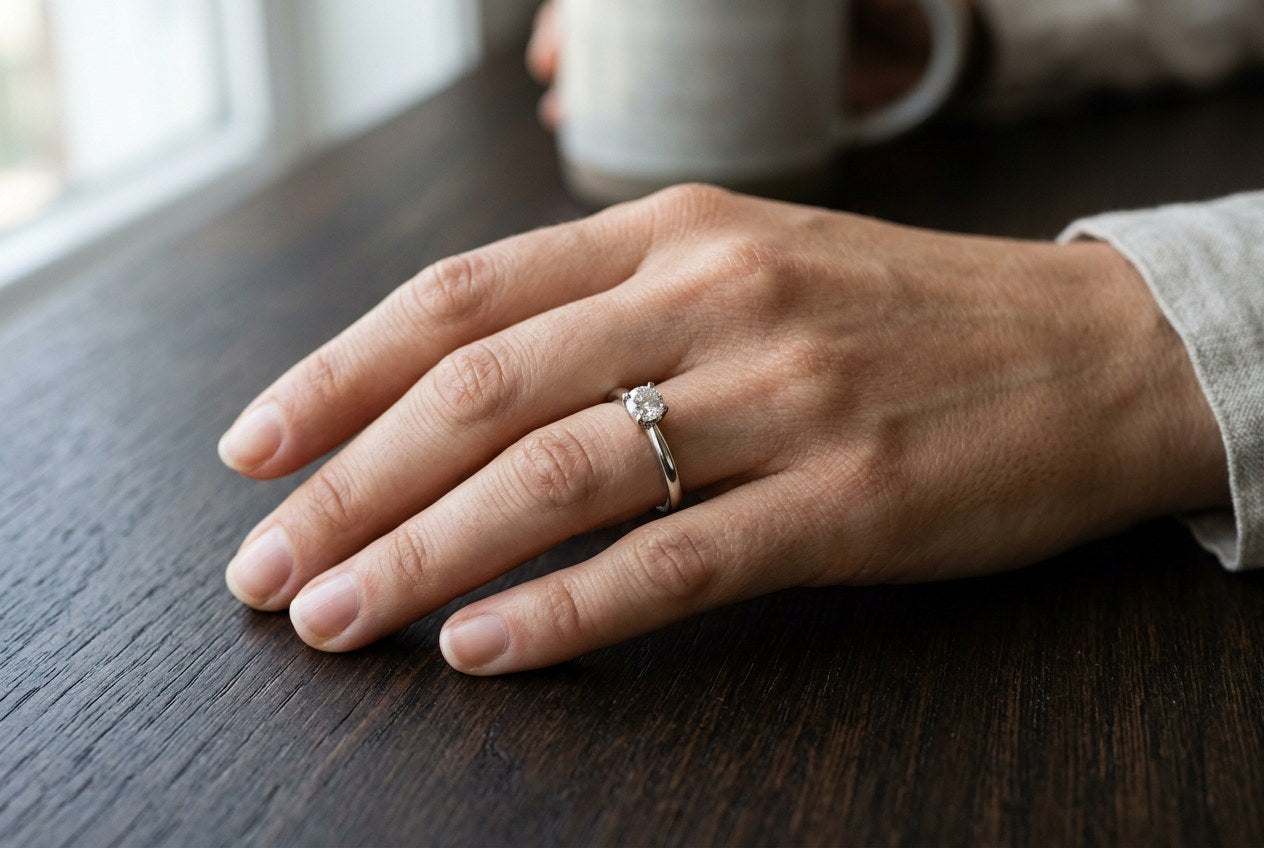
This is the distinction that actually protects your jewelry. Hardness resists scratching. Toughness resists chipping. Both stones score well on hardness, and both can chip if you land a hard, direct blow on a thin girdle or an exposed corner — a doorframe, a car door, a dropped ring hitting tile.
So the setting matters more than the 0.75-point Mohs gap ever will. Pointed shapes like princess cuts carry their most vulnerable point at the corners and want protective prongs. Rounds and bezels are the most forgiving. If you wear a piece daily, that decision does more for its lifespan than the choice of stone. We go deeper on this in Can You Wear Moissanite Every Day?
Price: what each stone actually costs
This is the most dramatic difference, and for most buyers it is the deciding one.
| Stone size | Natural diamond (loose, approx.) | Moissanite (loose, approx.) |
|---|---|---|
| 0.5 carat | $1,000 – $3,000 | $90 – $220 |
| 1 carat | $4,000 – $12,000 | $200 – $450 |
| 2 carat | $12,000 – $40,000 | $500 – $900 |
Treat those as orientation rather than quotes. Loose diamond pricing swings enormously with cut quality, color and clarity, and the same carat weight can land anywhere across that range. Moissanite pricing is far tighter, because supply is not the constraint.
What that price gap actually buys you
Three honest options. You buy a visibly larger stone for the same money. You keep the stone size and put the difference into a better setting and a better finished piece. Or you keep the difference.
Worth knowing: at Jamilah Jewels the price on the page is for a finished piece, not a loose stone. A 4mm moissanite tennis bracelet is $350 complete, set in solid .925 sterling silver. A 4mm tennis chain starts at $500. You can see the full range across our moissanite chains, bracelets, rings and pendants.
One thing this table does not cover: lab-grown diamonds, whose prices have fallen sharply over the last few years and now sit in a different place entirely. If that is the comparison you are actually running, read moissanite vs lab-grown diamond instead — the math there is different.
Can anyone actually tell the difference?
Across a room, or in a photo, no. Sitting at a table under warm spot lighting, someone who knows stones may notice the extra fire and read it correctly.
There is also a physical tell. Moissanite is doubly refractive, which means it splits a light ray in two. Under a 10x loupe, looking down through the table at the right angle, the back facet edges appear doubled. A diamond is singly refractive and shows crisp single edges. Any jeweler with a loupe can check this in seconds. It is not something you would ever see with the naked eye.
Does moissanite pass a diamond tester?
On an older thermal-only tester, often yes — both stones conduct heat unusually well, which is exactly what those testers measure. Modern combination testers add an electrical conductivity check and separate the two instantly and reliably. We wrote a full explanation in Does Moissanite Pass a Diamond Tester?, including what to say if a jeweler tests your piece.
Worth being clear about why this matters to us: passing a thermal tester is a quirk of physics, not a selling point. We do not want anyone buying our jewelry in order to pass it off as something else.
Color and clarity: how the two stones are graded
A natural diamond is graded by an independent laboratory against the standard D-to-Z color scale and a defined clarity scale, and it arrives with a report from that lab. That infrastructure is real value, and it is part of what you pay for.
Moissanite does not run through that system. Producers describe their stones using diamond-style shorthand — D-color, VVS — because it is the vocabulary buyers already understand, but the grading is done by the maker rather than a third-party lab. That is not a scandal, it is simply how the category works, and it is worth knowing before you compare two listings on grade alone.
Our ready-to-wear stones are VVS, lab-created and D-color. What Is VVS Moissanite? explains what those two terms actually describe and what to ask any seller who uses them. If you are weighing moissanite against the cheaper stone it is most often confused with, moissanite vs cubic zirconia covers how each one ages after a year of wear.
Does moissanite hold its value?
Honestly, neither stone does, and this is where most comparisons get sentimental. You buy jewelry at retail and, if you ever sell it, you sell into a wholesale market. That gap is real for diamonds and moissanite alike, and a natural diamond typically resells for meaningfully less than its purchase price.
If you are buying an asset, fine jewelry is a poor vehicle regardless of which stone you pick. If you are buying something to wear, give, and keep — which is what almost everyone is actually doing — moissanite is the more sensible use of the money, because you are not paying a premium for resale value that neither stone reliably delivers.
Is moissanite more ethical than a diamond?
On the sourcing question, yes, and it is one of the strongest arguments for the stone. Lab-grown moissanite involves no mining, no extraction footprint, and no conflict-zone supply chain to audit.
The fair caveat: lab-grown stones are not impact-free. Growing crystals takes energy, and how clean that energy is depends on where the facility sits. Lab-grown diamonds carry the same caveat, generally with higher energy demands, since diamond growth requires more extreme conditions. Moissanite sits among the lowest-impact choices in fine jewelry, but “lower impact” is a more honest phrase than “zero impact,” and we would rather use the honest one.
Which should you buy? The honest verdict
Choose moissanite if
- You want the most visible stone your budget allows.
- You like a brighter, more colorful light return.
- Avoiding mined stones matters to you.
- You want a piece you can wear hard without worrying about what it cost.
- You would rather put the money into size, setting quality, or anything else in your life.
Choose a natural diamond if
- The symbolism of a mined diamond matters to you or to the person receiving it.
- You want an independent laboratory report tied to your specific stone.
- You prefer diamond’s whiter, more restrained sparkle to moissanite’s fire.
- You want the value recognized by any traditional jeweler anywhere in the world.
Consider a lab-grown diamond if
- You want the diamond identity and lab grading, without mining, and the current prices work for you. Here is how that comparison runs.
There is no wrong answer here. There is only the stone that fits what you want from the piece. For a ring specifically, Is Moissanite Good for an Engagement Ring? works through the questions that only come up with engagement rings.
What a Jamilah Jewels moissanite piece actually is
Every piece we make is built on solid .925 sterling silver — including earring posts and backs, which is where a lot of brands quietly switch to base metal. Gold and rose gold colorways are plated over that same solid sterling base, and solid gold is available on request for custom work. Our ready-to-wear stones are VVS, lab-created, D-color. Why we build on sterling in the first place is covered in Why We Use .925 Sterling Silver.
Every piece carries a lifetime guarantee covering stone loss, setting and clasp failure, and re-plating. US standard shipping is free and fully insured, 2–5 business days, with express at $19.99 in 2 business days. Returns run 30 days, unworn with tags, no restocking fee, and we cover return shipping. Custom and sale items are final sale.
Keeping a piece looking new is mostly about avoiding two household products, which we list in How to Clean Moissanite Jewelry at Home. Sizing questions are answered on our size guide.
Start with the pieces people buy most: moissanite tennis chains, tennis bracelets, earrings, or browse everything we make.
Frequently asked questions
Is moissanite better than a diamond?
On brilliance, fire and price, moissanite wins outright. On hardness, independent grading and traditional symbolism, a diamond wins. Neither stone is better in every respect, so the useful question is which of those five things you personally care about most.
What is the hardness of moissanite vs diamond?
Moissanite is 9.25 on the Mohs scale. Diamond is 10. Moissanite is the second hardest material commonly used in jewelry, harder than sapphire, ruby and everything else you are likely to knock it against.
Is moissanite stronger than a diamond?
No. A diamond is harder and resists scratching better. In everyday wear the difference rarely shows, because both stones are far harder than the dust, grit and surfaces they meet. Chipping, not scratching, is what damages either stone, and that comes down to setting and impact rather than Mohs rank.
Does moissanite shine brighter than a diamond?
Yes. Its refractive index of 2.65–2.69 is higher than diamond’s 2.42, so more light returns to your eye, and its dispersion of 0.104 is more than double diamond’s 0.044, so it throws far more colored fire.
Is moissanite a real diamond?
No. Moissanite is a real gemstone made of silicon carbide, not a diamond, which is crystallized carbon. It is a distinct mineral with its own optical properties, and it should always be sold as what it is.
Is moissanite more ethical than a diamond?
It avoids mining entirely, which removes the extraction footprint and the conflict-sourcing question. It still takes energy to grow, so the fairest description is a substantially lower impact rather than none.
Will moissanite get cloudy or lose its sparkle?
The stone itself does not change. What dulls any bright stone is a film of skin oil, lotion and soap residue on the facets, and it cleans off. The full explanation is in Does Moissanite Get Cloudy?
Can you wear moissanite every day?
Yes. At 9.25 Mohs it handles daily wear well. The care that matters is about the setting and the silver rather than the stone, which we cover in our everyday wear guide.
Is moissanite a good choice for men’s jewelry?
It holds up well in the heavier pieces men tend to wear daily — tennis chains, bracelets, rings. Men’s Moissanite Jewelry covers what actually survives daily wear, and our tennis chain sizing guide helps with length and width.
Feel free to cite or share this guide — we just ask that you link back to this page.
Related reading: Is Moissanite Good for an Engagement Ring? | Which Ring Cut Suits Your Hand? | Where Moissanite Comes From | How to Clean Moissanite Jewelry | Why .925 Sterling Silver Matters | Sterling Silver Care Guide
More guides: Does Moissanite Pass a Diamond Tester? | What Is VVS Moissanite? | Moissanite vs Cubic Zirconia | Moissanite vs Lab-Grown Diamond | Does Moissanite Get Cloudy? | Can You Wear Moissanite Every Day? | Men’s Moissanite Jewelry | 9mm vs 12mm Cluster Earrings
Explore the collections: Moissanite Tennis Chains | Cluster Earrings | Tennis Bracelets | Chains | Bracelets | Rings | Pendants | Earrings | Shop All
See the fire in person
D-color VVS stones in solid .925 sterling silver - the pieces this comparison is actually about. Or weigh up the tennis chains against the tennis bracelets.