

Home / Jamilah Jewels Blog | Moissanite, Jewelry Guides and Buying Advice / Cluster, Halo, Pavé or Single Stone: Which Studs to Buy?
Cluster, Halo, Pavé or Single Stone: Which Studs to Buy?
October 1, 2026

The short answer: a cluster gives you the most visible face for your money, a halo gives one stone a bigger outline without the busy look, a single stone is the cleanest and most formal, and pavé is about shape rather than size. Pick the setting first, then the size. Do it the other way around and you end up with a 12mm pair you only wear twice.
Most earring guides talk about stone shape and millimeters. Those matter, and we cover both in the moissanite earrings buying guide. But the decision people get stuck on is the setting: how the stones are arranged on the face of the earring. That is what decides whether a pair reads as quiet, polished, or loud from across a room, and it is the difference between a $100 stud and a $200 one.
What the setting actually changes
Setting is the arrangement of stones and metal on the visible face of the stud. It controls three things that matter when you wear the earrings:
- Apparent size. Many small stones grouped together cover more surface than one stone of the same budget.
- How the sparkle behaves. One large stone throws a few big flashes. Many small stones throw constant fine glitter.
- How formal it reads. Clean geometry reads dressy. Dense sparkle reads bold.
Everything else on a well-made stud — the metal, the backing, the stone grade — is independent of the setting. At Jamilah Jewels those stay consistent across all four types, which is covered further down.
Single-stone studs: the cleanest read
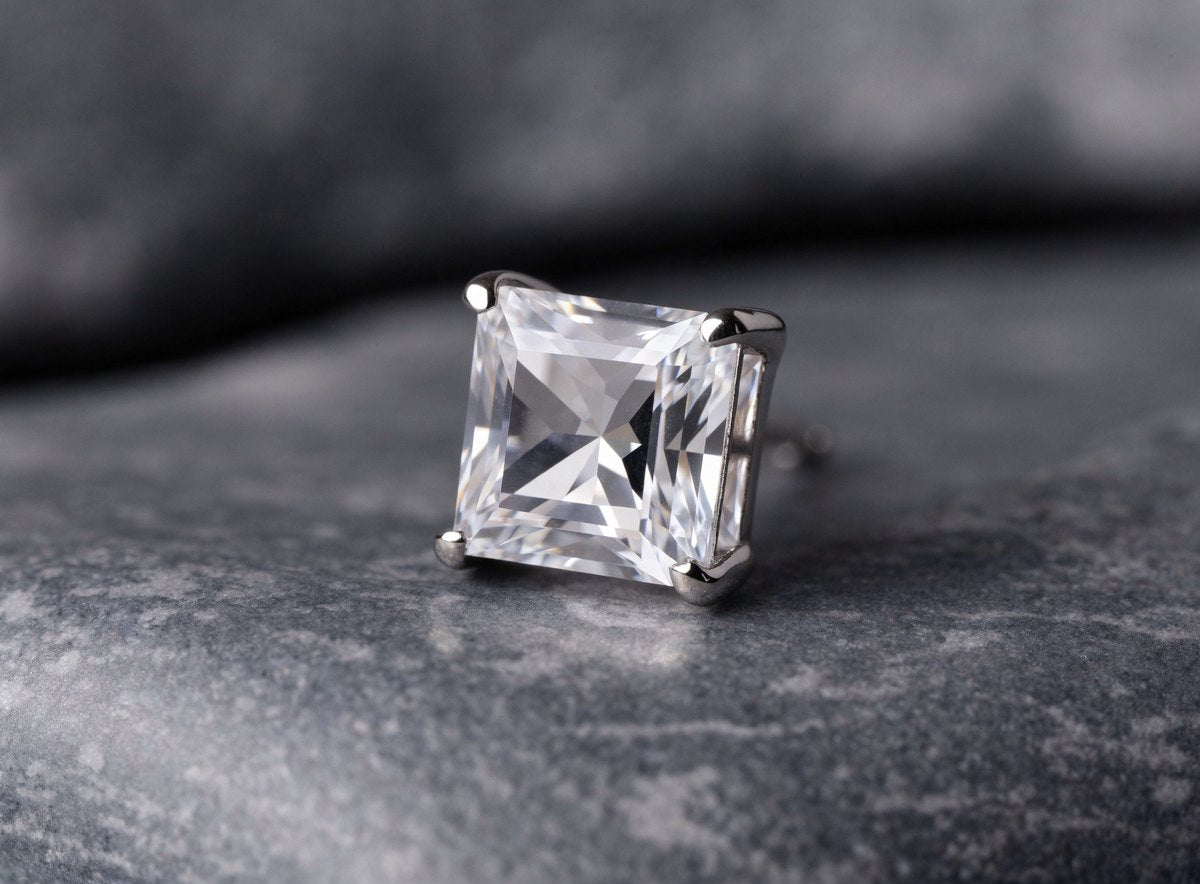
One stone, held in prongs, nothing else. This is the setting most people picture when they hear "stud earring," and it is the most formal of the four. The outline is small and defined, so it disappears under a high collar and never competes with a necklace.
The trade-off is simple: you are paying for one stone, so the visible face is the smallest of the four settings at any given price. A single-stone stud has to earn its presence through cut quality rather than coverage.
Our Luxe Princess Cut VVS Lab Stone Earrings are the clearest example at $140. One square princess-cut lab-grown stone per ear, set in four prongs in genuine .925 sterling silver with a rhodium finish. The square outline reads slightly more modern than a round stone would; if you are weighing those two shapes, we compared them directly in princess-cut vs round moissanite studs.
Choose single-stone if you want one pair that works at a wedding, an interview, and the office, and you would rather have an obviously clean stone than a bigger footprint.
Halo studs: one stone, borrowed size
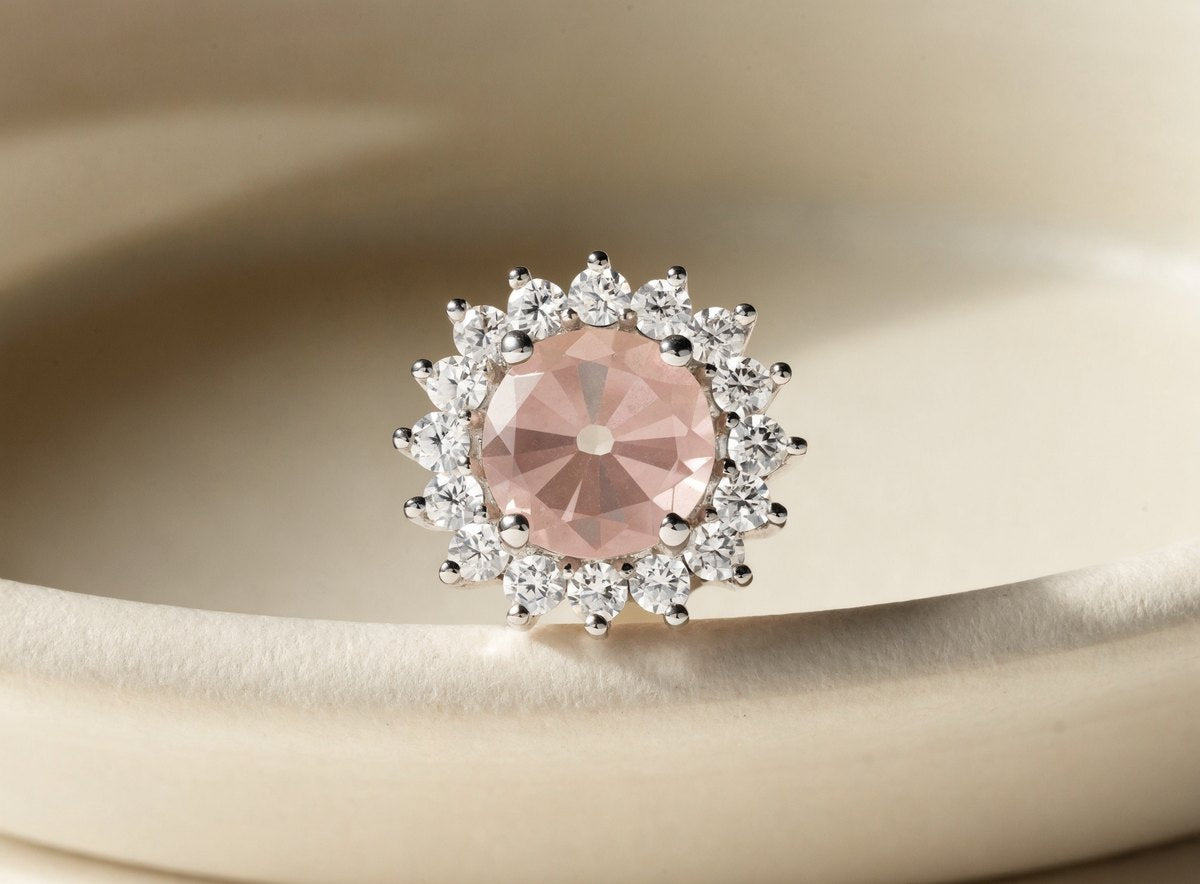
A halo is one center stone ringed by a single row of much smaller stones. The ring of small stones widens the outline of the earring without adding a second focal point, so the center stone still reads as the subject. It is the setting that looks the most like a miniature ring on the ear.
Halos suit a colored center stone particularly well, because the clear ring frames the color instead of fighting it. Our 'Rose Light' Petal Halo Earrings at $200 do exactly that: a soft pink round center stone inside a petal-shaped halo of clear stones, on sterling silver. From a distance it reads as a flower rather than as a pile of stones, which is the practical difference between a halo and a cluster.
Choose halo if you want more width than a single stone gives but you still want one stone to be the point of the earring.
Cluster studs: the most face for the money
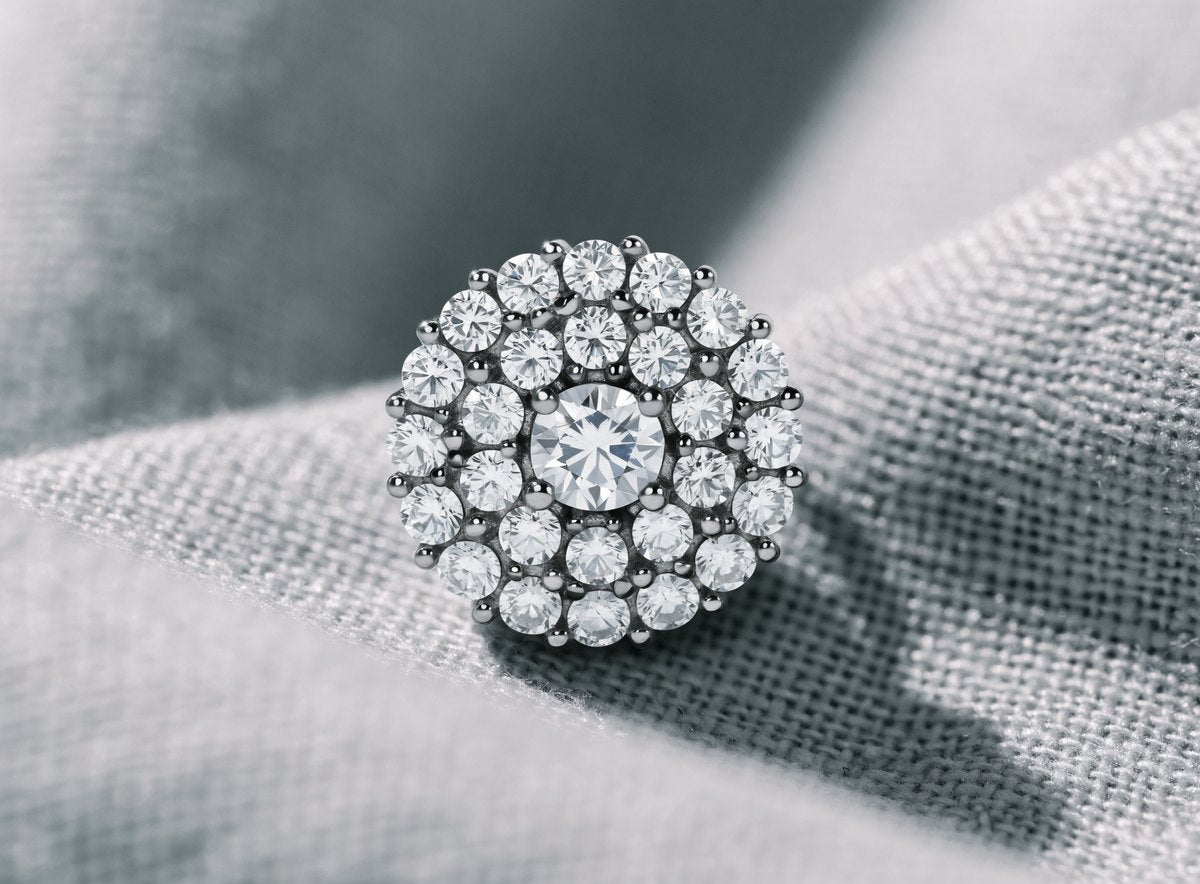
A cluster is many stones set tightly together across the whole face, usually with a slightly raised center stone. There is no single hero stone; the group is the design. This is the setting that gives you the largest visible earring per dollar, which is why it is the best-selling style in our moissanite cluster earrings collection.
Because the stones are small and numerous, the sparkle is continuous rather than flashy — it glitters when you move your head instead of throwing one big flash. That constant movement is what makes clusters read as "iced out" at a glance.
Two sizes cover most people:
- 9mm cluster earrings at $140 in silver or gold finish. The everyday size — visible across a room, still easy to wear to work.
- 12mm cluster earrings at $170 in gold or silver finish. A third wider, and it shows in photos.
Both are set with VVS1 lab-grown moissanite clustered around a raised center stone, in genuine .925 sterling silver with a rhodium finish and screw-back posts. Both also come in a pink stone option, at $200 for the 9mm and $220 for the 12mm. If you are torn between the two widths, 9mm vs 12mm cluster earrings walks through it, and the two-minute earring size method settles it faster than holding a ruler to your ear.
Choose cluster if you want the earring to be noticed, or you want the largest face you can get for $140 to $170.
Pavé and shaped studs: shape first, sparkle second
Pavé means tiny stones set flush and close along a surface so the metal nearly disappears. In a stud, pavé is almost always used to trace a shape rather than to fill a circle. That makes this group the odd one out: you are buying the silhouette, and the stones are there to make the silhouette catch light.
It is also the most personal of the four settings, because the shape carries meaning the other three do not.
- Timeless Heart Pavé Earrings at $120, a heart outline traced in pavé-set VVS lab stones on .925 sterling silver, with screw-backs. Currently available in silver and rose gold.
- 'Luxe Clover' Timeless Earrings at $100, our lowest-priced stud and the most wearable shaped option.
- Elegant Snowflake Starburst Earrings at $150, a radiating burst pattern that sits visually between pavé and cluster.
- 'Hexaluxe' Regal Statement Earrings at $150, a six-sided geometric face with a high-polish rhodium finish.
Choose pavé or a shaped stud if you want the earrings to look like a design choice rather than a size choice, or you are buying a gift and want something less generic than a plain stud.
Which setting looks biggest?
Ranked by how much of the ear the earring visibly covers, at a similar price:
- Cluster — the widest face per dollar.
- Halo — wider than one stone, narrower than a cluster.
- Pavé or shaped — depends entirely on the shape; a heart outline can be wide but reads lighter because it is mostly open.
- Single stone — the smallest visible footprint.
"Biggest" is not the same as "best," though. A 12mm cluster is the right answer if you want to be seen and the wrong answer if you mostly wear earrings to meetings.
How to choose, in three questions
Where will you wear them most?
Count the days, not the occasions. If four days in five are work or errands, buy for those days and the fifth day will still be fine. Clean settings scale up to formal; loud settings do not scale down.
How much face do you want?
Hold a coin against your earlobe. A US dime is about 18mm across and a 9mm stud is roughly half that. Our mm to carat size guide translates millimeters into the carat numbers you will see elsewhere, which helps when you are comparing us to another store.
What are you actually comparing on price?
Between two studs at the same price, the cluster has more stones and a wider face, and the single stone has one larger, better-displayed stone. Neither is a better deal — they are different purchases. What should never differ is the metal and the stone grade, which is where a lot of cheap moissanite jewelry quietly cuts corners.
What stays the same across all four
The setting changes the look. These do not change, whichever you pick:
- Stones. Lab-grown moissanite, VVS clarity on the pieces graded for it. Moissanite is its own gemstone, not a diamond and not cubic zirconia, and unlike CZ it does not dull or cloud with age — see how each one ages after a year and what VVS actually means.
- Metal. Genuine .925 sterling silver, rhodium finished to slow tarnishing. What .925 sterling silver actually means explains why that matters more than the word "silver" on a listing. Gold and rose gold pieces are plated over the same sterling base, and plating wear is worth reading before you choose a finish.
- Backings. Screw-back posts on our stud earrings. If you have ever lost an earring off a push-back, screw backs vs push backs is the two-minute version of why.
- Comfort. Sterling silver suits most people who react to cheap alloys, though it is not the same as nickel-free — is sterling silver hypoallergenic covers the honest version.
Frequently asked questions
Do cluster earrings look bigger than a single stone of the same price?
Yes, noticeably. A cluster spreads your budget across many small stones, so the face of the earring is wider. A single stone concentrates it, so the earring is smaller but the one stone is larger and more visible on its own.
What is the difference between a halo and a cluster?
A halo has one clear center stone with a single row of smaller stones around it, so your eye goes to the center. A cluster has many similar stones across the whole face with no single focal point. Halos read as one piece of jewelry; clusters read as a field of sparkle.
Is pavé or cluster better for everyday wear?
Pavé and shaped studs usually sit flatter and smaller, so they tend to be easier for all-day wear. Clusters are not difficult to wear, but a 12mm cluster is a deliberate choice rather than a background one. Either way, keep the settings clean — how to clean cluster and pavé studs covers the small-stone settings specifically, since they trap more than a single stone does.
Which setting is best for a gift?
A shaped pavé stud or a 9mm cluster. Both avoid the two things that make jewelry gifts go wrong: they need no size measurement, and they are specific enough to feel chosen rather than defaulted to.
Do more stones mean more sparkle?
More points of sparkle, not more total brilliance. Many small stones produce fine, constant glitter. One large stone produces fewer but bigger flashes. Which looks like "more" depends on the light and on what you find attractive.
Can I mix settings between my earrings and the rest of my jewelry?
Yes, and it usually looks better than matching everything. A common approach is one dense piece and the rest quiet: cluster studs with a plain chain, or a single-stone stud with a fully set bracelet.
Pick your pair
If you want one pair to cover everything, start with the Luxe Princess Cut studs at $140. If you want to be seen, start with the 9mm cluster earrings at $140 and size up to 12mm only if you already know you like bold earrings. If you are buying a gift, the Timeless Heart Pavé Earrings at $120 are the safest specific choice we sell.
Every pair above is set in genuine .925 sterling silver with lab-grown moissanite, and every one is in stock today. Browse the full moissanite earrings collection to see all four settings side by side.