

Home / Jamilah Jewels Blog | Moissanite, Jewelry Guides and Buying Advice / Moissanite Ring Cuts: Which Shape Suits Your Hand?
Moissanite Ring Cuts: Which Shape Suits Your Hand?
March 19, 2026

If you are shopping for a moissanite ring built around a single center stone, the shape you choose changes three things at once: how the stone reads on your hand, how much rainbow fire you see, and how easy it is to tell whether the stone was cut well. Most shape guides only cover the first one.
Here is the short answer. Round brilliant suits every hand and hides the most cutting sins. Oval and pear make shorter fingers look longer. Emerald and princess sit well on longer, more angular hands. Cushion works almost anywhere. If you want the lowest risk of buying a badly cut stone, buy round. If you want the strongest finger-lengthening effect, buy oval. The rest of this page is the reasoning, plus two checks that matter more than hand shape and that almost nobody tells you to run.
Shape and cut are not the same word
The jewelry trade uses the word cut to mean two different things, and the confusion costs people money.
Shape is the outline: round, oval, cushion, emerald, pear, princess. It is what you see from across a room.
Cut is the faceting and the proportions: how many facets, at what angles, how deep the stone sits, how well its halves match. It is what decides whether the stone actually returns light to your eye.
Two ovals with an identical outline and identical carat weight can look completely different, because one was cut to hold weight and the other was cut to perform. When someone tells you to get a well cut stone, this second meaning is what they mean, and on most shapes it is the part you have to assess for yourself.
The six shapes, and the hand each one flatters

Round brilliant
The classic arrangement of 58 facets, engineered over a century to send as much light as possible back up through the top of the stone. It works on every hand: it lengthens a narrow finger slightly and holds its own on a broad one without looking oversized. On a small hand it reads delicate rather than dominant.
Round is also the most forgiving shape to buy, for two reasons. Its symmetry means asymmetry is obvious the moment you look straight down at it. And it is the only shape in this list that any laboratory issues an overall cut grade for, which matters more than it sounds. That is covered below.
Oval
An elongated brilliant. It has the strongest finger-lengthening effect of the six, which is why it is the usual recommendation for shorter or wider fingers, and it keeps almost all of the sparkle of a round.
Ovals vary far more than rounds do, and the number that captures it is the length to width ratio. GIA's own guidance is that a ratio between 1.30 and 1.40 gives a more rounded look, while 1.40 to 1.50 is the traditional oval shape. Ask a seller for that number before you buy. It is a measurement, not an opinion.
Cushion
Square or rectangular with softly rounded corners. It sits comfortably on most hands, reads a little larger face up than a princess of the same weight, and has no sharp corners to catch on clothing. The faceting produces broader, chunkier flashes than a round, which some people prefer and others find less lively.
Emerald
A step cut rather than a brilliant cut: a rectangle with cut corners and long parallel facets running in tiers, so you look down into the stone rather than at a field of scattered sparkle. It flatters longer fingers and it is the most understated shape here.
It is also the one shape where the advice for moissanite genuinely differs from the advice for diamond, for an optical reason set out further down this page. Read that section before you commit to one.
Pear
A teardrop, brilliant faceted, with a rounded end and a point. It lengthens shorter fingers well and has a distinctly less conventional look than an oval.
The point is the vulnerable part. It should sit under a prong shaped to cover it, usually a V-shaped one, and it is the first place a stone takes a knock. Ask how the point is held before you buy.
Princess
Square with sharp corners and brilliant faceting. It reads modern and architectural and suits longer, more angular hands. Two things to know: it has four exposed corners rather than one, each of which needs a prong covering it, and it reads smaller face up than a round of the same carat weight, because more of its weight sits below the surface in the depth of the stone.
| Shape | Flatters | Watch for |
|---|---|---|
| Round | Every hand | Nothing structural |
| Oval | Short or wide fingers | Bow tie, L:W ratio |
| Cushion | Most hands | Softer, broader flash |
| Emerald | Long fingers | Doubling, see below |
| Pear | Short fingers | Bow tie, exposed point |
| Princess | Long, angular hands | Four exposed corners |
Hand-shape rules are conventions, not measurements
Everything in the section above is styling convention. It is useful, it is what most people mean when they ask which shape suits their hand, and it rests on a sensible visual idea: a shape drawn along the length of a finger continues the line of that finger. But nobody has measured it, and you will find guides that confidently contradict each other on the same shape.
So treat it as a starting point rather than a rule. If you love an emerald cut and you have short fingers, buy the emerald cut. A shape somebody talked you out of is the one you stop wearing.
The part nobody grades for you
This is the section worth reading twice, because it is the difference between the shape you pick and the stone you actually receive.
GIA assigns an overall cut grade to round brilliant diamonds only. Every other shape, which the trade calls a fancy shape, does not get one. GIA's wording is that oval diamonds "do not receive a cut grade, since they can vary more in proportions and faceting style". Polish and symmetry are still assessed and reported. The overall judgment of whether the stone was cut to perform is not.
A second layer applies to moissanite specifically. As covered in our guide to what VVS moissanite actually means, GIA does not issue 4Cs grades for moissanite at all. Every color and clarity description attached to a moissanite, ours included, is assigned by the manufacturer or the seller rather than by an independent laboratory.
Put those two together. Buy a round diamond and a laboratory has already judged the cut for you. Buy a fancy-shape moissanite and nobody has. You are the cut grader. That is not an argument against fancy shapes. It is an argument for looking properly, which takes about thirty seconds.
What to look at:
- Symmetry. Look straight down at the stone and mentally fold it in half, first along its length and then across it. On an oval or pear, uneven shoulders are the most common flaw and the easiest to catch.
- Dark areas that stay put. Sparkle moves when you tilt a stone. A dead patch that stays dark through the whole tilt is a proportion problem, not a lighting one.
- The length to width ratio on any elongated shape. Ask for it as a number rather than accepting a description.
- How the point or corners are held on a pear or a princess.
The bow tie, and how to look for it
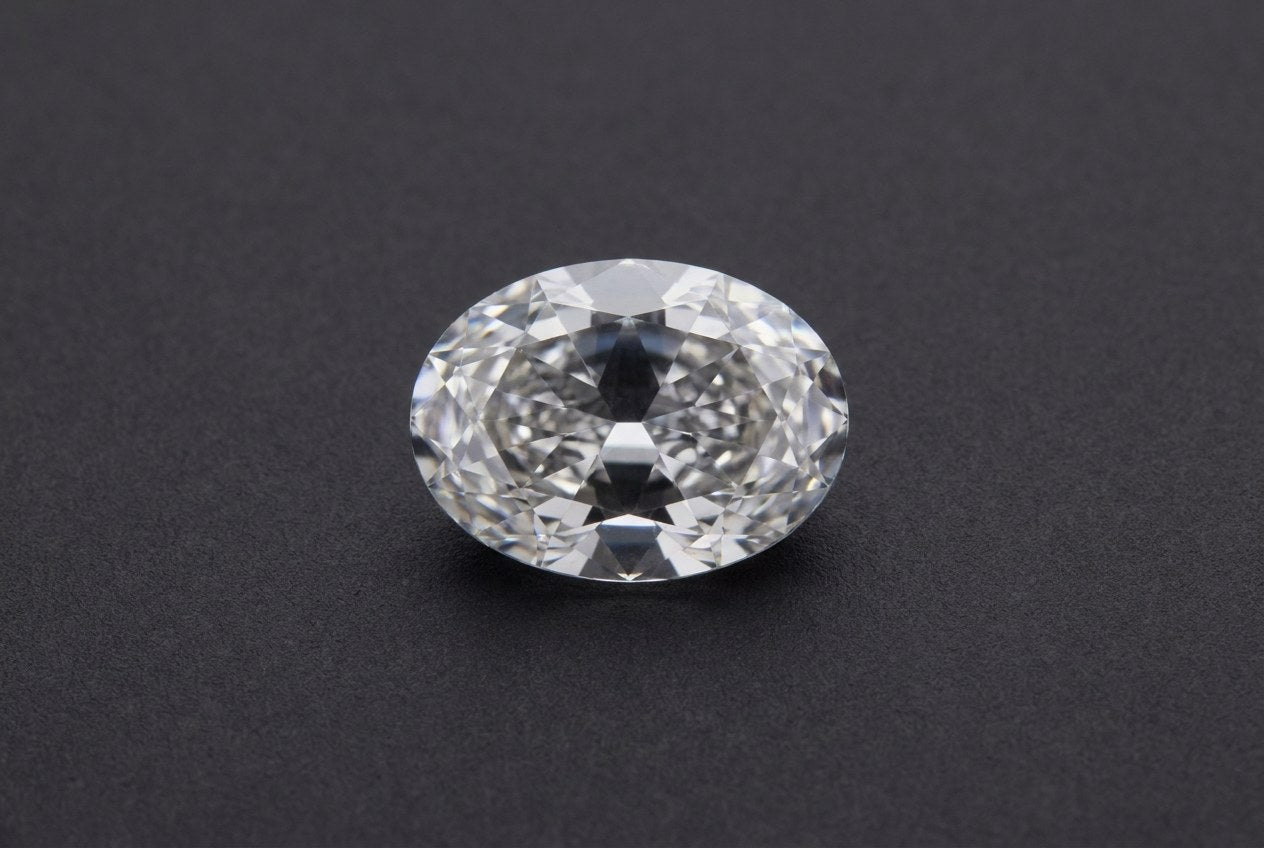
If you are considering an oval or a pear, this is the single most useful thing on this page.
A bow tie is a darker band running across the narrow middle of an elongated stone, roughly the shape its name suggests. GIA describes the cause plainly: it appears when part of the light reaching the stone is blocked "specifically by your own head and shoulders" as you lean over to look at it. You cast it yourself.
Two things follow from that. Some degree of bow tie is always present in these shapes, and GIA is explicit that a well cut stone minimizes it rather than removing it. And because you are the one blocking the light, you can only judge it in person or in an unedited video shot under ordinary lighting. A retouched product photograph will never show you one.
GIA's 2024 research on oval, pear and marquise diamonds, the three elongated shapes, found that the faceting layout is what drives how bad the band gets, and that the trade has moved away from the layouts that make it worse: by 2023 nearly 90 percent of the ovals submitted to GIA used an arrangement that keeps the bow tie small. The same work found that the length to width ratio people said they preferred peaked around 1.7, while most ovals actually submitted sat closer to 1.4. If you keep being shown ovals that look shorter than the one in your head, that gap is why.
How to check one: tilt the stone slowly under normal room light. A faint band that shifts and breaks up as you tilt is normal, and most people stop noticing it entirely once the ring is on a hand. A dark band that sits there unchanged through the whole tilt is a stone to pass on.
Why the emerald cut is a harder decision in moissanite
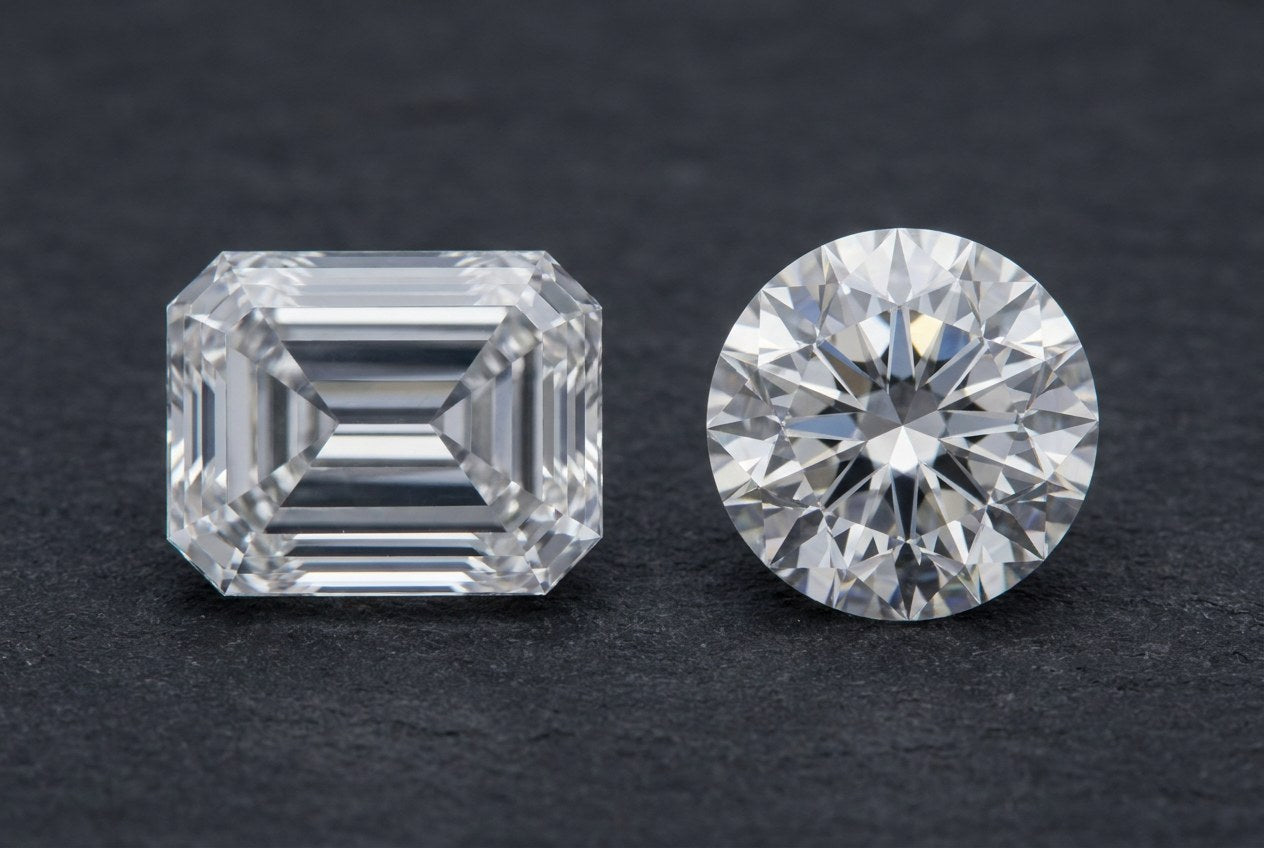
Most shape guides copy their emerald cut advice straight across from diamond without adjusting it. Moissanite is a different material and one of its properties lands directly on this shape.
Moissanite is doubly refractive. Published gemological measurements put its birefringence at 0.043, against zero for diamond, and the practical effect is an apparent doubling of facet junctions when you look closely into the stone. Its dispersion, the property that produces rainbow fire, measures 0.104 against 0.044 for diamond, which is where moissanite's much stronger fire comes from. Both figures are material properties, not quality grades.
Faceting decides how much of either you notice.
In a brilliant cut, meaning round, oval, cushion, pear or princess, the faceting is deliberately busy. Dozens of small facets scatter light in every direction, your eye reads the result as sparkle, and the doubling is effectively lost inside all that movement.
In a step cut like the emerald, the faceting is calm on purpose. You are looking down long open facets into the body of the stone, which is exactly the viewing condition where doubled facet junctions are easiest to see. The same openness that makes an emerald cut elegant in a diamond makes it the least forgiving shape in a moissanite.
This is not a reason to rule out an emerald cut moissanite. Plenty of people look at one closely and see nothing that bothers them. It is a reason to look at that particular shape in person, or in a close video, rather than buying it from a still photograph.
Which shapes show the most fire
Fire is the rainbow flash. Brilliance is the white sparkle. They are different effects and shapes trade between them. Because moissanite's dispersion is more than twice that of diamond, any moissanite shows more fire than a diamond of the same shape, but how much of it reaches you is partly the cut's decision.
- Most fire: round brilliant and cushion. Small facets at steep angles split light into color aggressively.
- Strong but more directional: oval and pear. Elongated brilliants throw longer flashes that read as movement when the hand moves.
- Least fire: emerald. Step facets return broad white flashes rather than splitting light into color.
So if the rainbow effect is the reason you want moissanite in the first place, choose a brilliant shape. If it is the part you are least sure about, a step cut gives you the most restrained version of the stone. Our comparison of moissanite and diamond covers how the two read side by side, and moissanite versus lab-grown diamond covers the closer of the two comparisons.
What we make ready to wear, and what we make to order
Worth being straight about this, because it decides where you go next.
The rings in our rings collection are design led rather than center stone led. They are .925 sterling silver set with VVS lab moissanite, and the stones are set in patterns rather than as one solitaire: baguettes forming the wings of the 'Free Spirit' Baguette Butterfly Ring, twin rows of round stones on the 'Infinite Motion' Two Row Ring, stones set into the link geometry of the 'Street Legend' Cuban Design Ring, and a clean angular setting on the 'Bold Legacy' Modern Edge Ring. If you want a ring to wear every day and not think about, that is what these are built for.
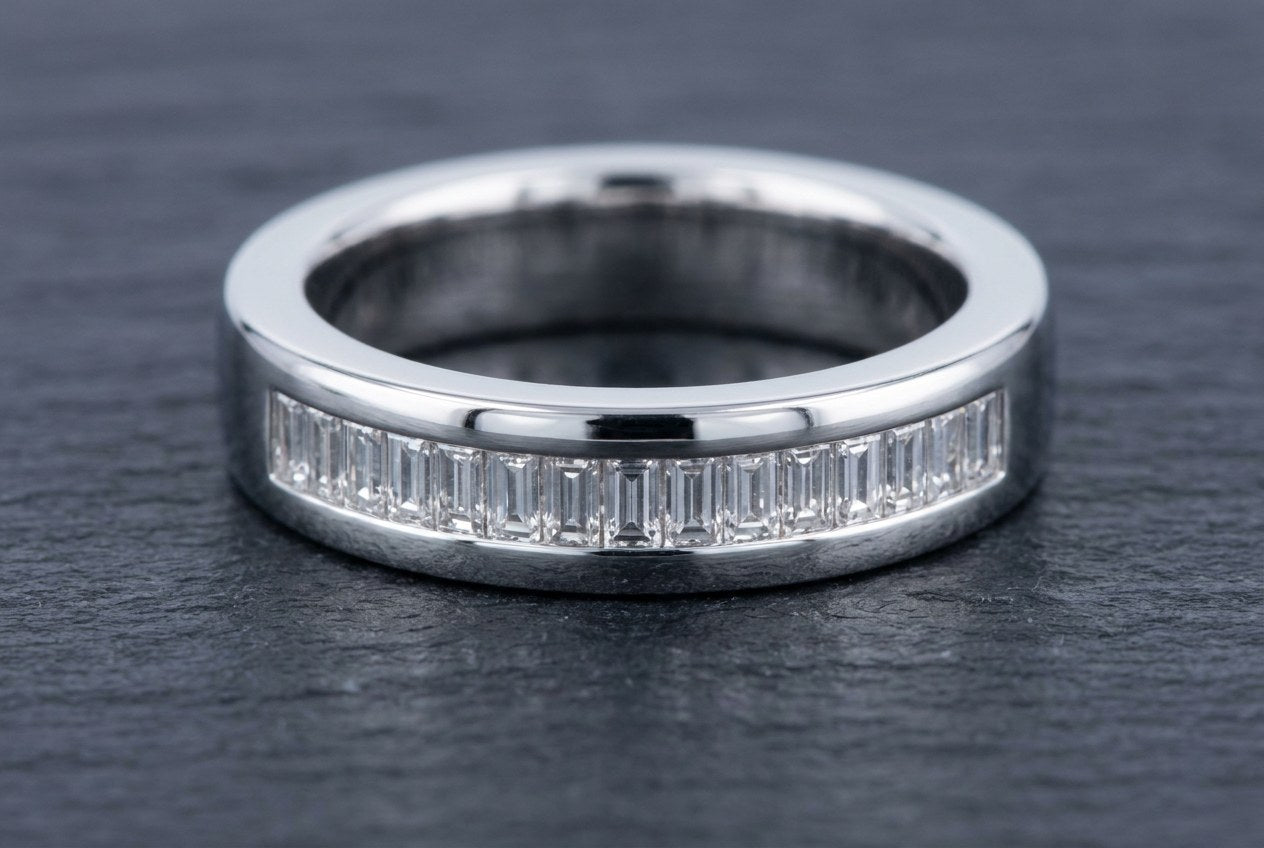
One shape does turn up constantly in that collection, and it is the one the shape guides never list: the baguette. It is a step cut, like the emerald, and set in a row it gives a clean architectural line that a row of round stones cannot. If the emerald cut appeals to you for its calm, the baguette is the same idea at a smaller scale.
A ring built around a single center stone in a shape of your choosing is custom work here rather than something you pick off a collection page. That route also opens up solid gold, and a lab-grown or natural diamond in place of moissanite if you want one. Our guide to how the custom process actually works walks through the stages, and the custom inquiry page is where to start with a concept and a budget.
Whichever route you take, get the size right first. Measuring your ring size at home takes two minutes with a strip of paper, and our size guide lists the millimeter equivalents. Once it is on your hand, cleaning moissanite properly and looking after sterling silver are the two things that keep it looking new.
Frequently asked questions
Which moissanite shape looks biggest for the carat weight?
Elongated shapes generally cover more finger for the same weight, because less of the weight is hidden in the depth of the stone. Oval and pear read largest face up. Princess reads smallest, since a square outline carries more of its weight below the surface. Our millimeter to carat size guide explains how the two measurements relate.
Does the shape change how durable the ring is?
The stone is equally hard whatever shape it is cut into. What changes is how exposed its edges are. Pear, marquise and princess have points or sharp corners that each need a prong specifically covering them. Round, oval and cushion have no exposed corners at all, which makes them the easier shapes for daily wear.
Is a bow tie a defect?
No. It is a consequence of the shape, and some degree of it is always present in an oval, pear or marquise. A faint band that moves and breaks up when you tilt the stone is normal. A dark band that stays fixed through the tilt points to poor proportions and is worth avoiding.
Can I get a certificate that grades the cut of my moissanite?
Not from GIA. GIA does not issue 4Cs grades for moissanite, and even for diamonds it assigns an overall cut grade only to round brilliants rather than to fancy shapes. Any color, clarity or cut description attached to a moissanite is the manufacturer's or the seller's own assessment. Our guide to VVS moissanite explains what those terms do and do not mean.
Which shape is best if I have never owned a moissanite before?
Round brilliant. It suits every hand, it is the most forgiving of small cutting errors, it shows moissanite's fire at full strength, and it has no points to protect. If you find the rainbow flash is more than you wanted, that tells you a step cut is your next stone.
Do you sell rings in all of these shapes?
Our ready-to-wear rings are pattern-set designs in .925 sterling silver rather than single center stone rings, so the shapes on this page mostly apply to custom work. A ring built around one stone in a chosen shape starts on our custom inquiry page. If you are weighing up the stone itself first, is moissanite good for an engagement ring is the place to start.
Choosing yours
Pick the shape you keep coming back to, then spend thirty seconds on the two checks that actually matter: look for a dark patch that does not move, and on any elongated stone ask for the length to width ratio as a number. Those two questions will do more for how your ring looks in five years than any hand-shape rule.
Browse the rings collection if you want a piece to wear daily, or tell us what you have in mind if you want a single stone in a shape of your choosing. If you are not sure moissanite is the stone yet, the honest economics of moissanite is a good next read.