

Home / Jamilah Jewels Blog | Moissanite, Jewelry Guides and Buying Advice / How to Clean Cluster and Pavé Stud Earrings
How to Clean Cluster and Pavé Stud Earrings
September 3, 2026

Cluster and pavé studs are the easiest jewelry you own to wear and the easiest to clean badly. The dirt on them is almost never on the stones. It is behind the stones, in the gaps a polishing cloth cannot reach and a towel cannot dry, and almost every cleaning guide online is written for a ring with one big stone in the middle.
This is the version for a stone-dense face: what actually builds up on an earring, how to lift it without touching the setting with anything abrasive, the drying step nearly everyone skips, and the extra rule that applies if your pair is a gold or rose gold colorway.
The short answer
Warm water, one drop of mild dish soap, a five to ten minute soak, then a soft brush worked from behind the stone field rather than across the top of it. Rinse in a second bowl of clean water instead of under a running tap. Blot, then stand the pair on edge to air dry so the water trapped under the stones can run out instead of sitting there.
That is the whole method. The rest of this guide is why each step is shaped that way, because on a cluster setting the reasons change what you do. For the general routine that applies to every piece we make, our guide to cleaning moissanite jewelry at home is the place to start.
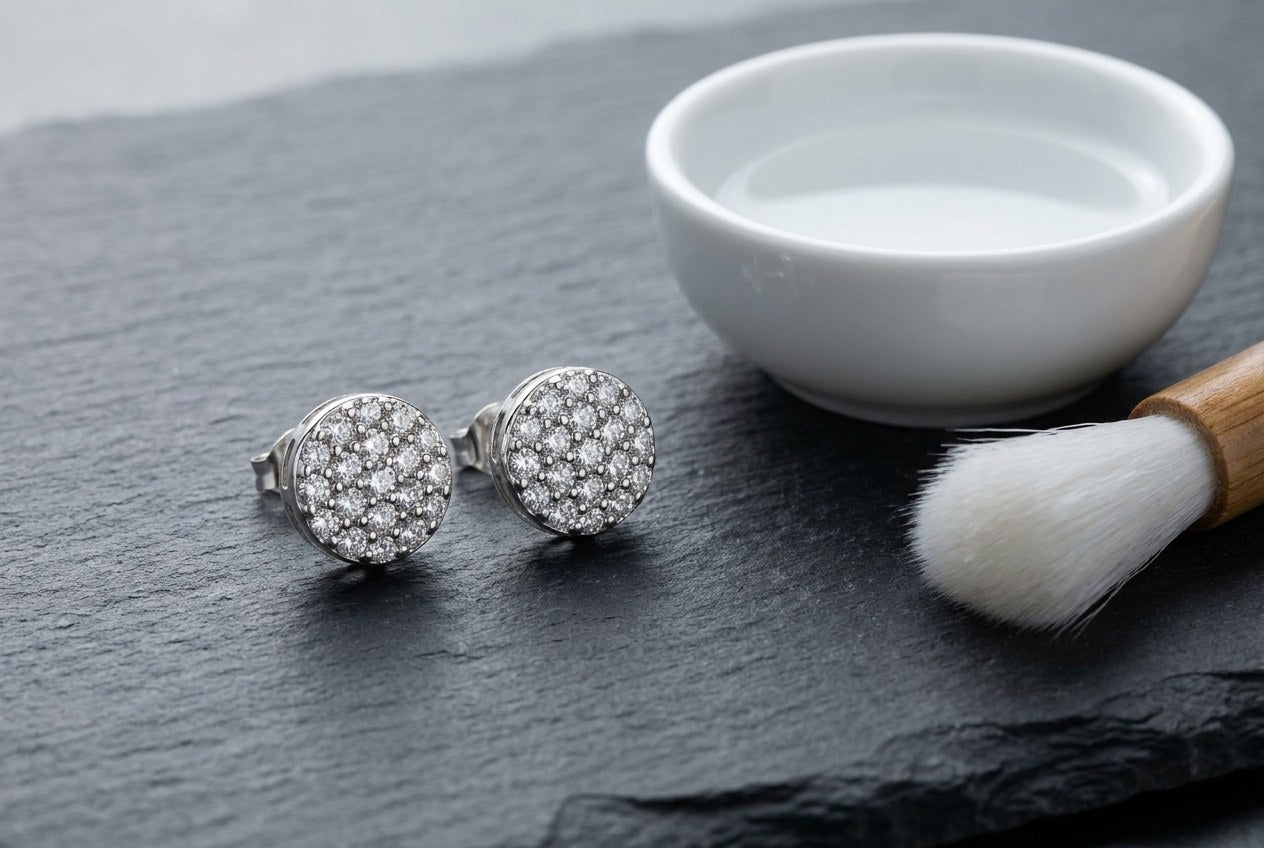
Why a cluster face gets dirty in a way a ring never does
A ring lives on a hand. Hands get washed several times a day, which means rings get an unintentional rinse several times a day, and the buildup on them tends to be lotion and soap scum.
Earrings live in a spray zone. Hairspray, dry shampoo, perfume, sunscreen and setting spray are all aimed at roughly the height of your earlobe. Nothing rinses them off, because nobody washes their ears the way they wash their hands, and studs are one of the few pieces people genuinely wear around the clock, including through sleep. Add the skin's own sebum, which the earlobe produces steadily, and you get a thin oily film rather than grit.
That distinction matters. Grit needs to be lifted away carefully so it does not drag across metal. A film needs to be dissolved, which is a question of soak time and a wetting agent, not of pressure. It is the single most common mistake on stone-set studs: people scrub something that only needed to sit in soapy water for a few minutes.
The Gemological Institute of America makes the same general point about cosmetics, though its warning is aimed at porous and delicate gems, where hairspray and perfume can permanently damage the surface. Moissanite is neither porous nor delicate, so the film on your studs is a cosmetic problem, not a chemical one. It still dulls them, and it still has to come off.
The geometry problem: dirt is behind the stones, not on them
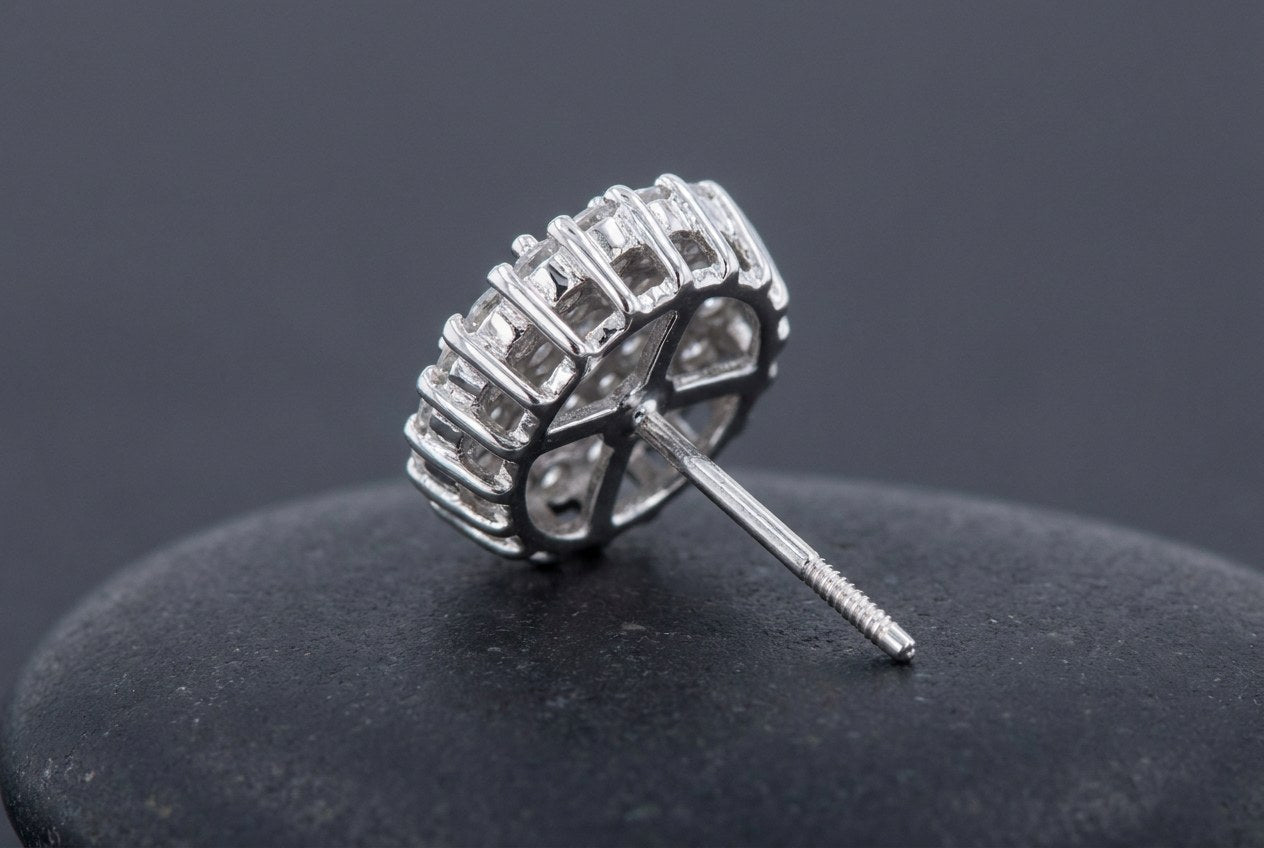
On a cluster or pavé face, small stones are set tight against each other, often with their widest points nearly or actually in contact. That is what produces the unbroken sheet of light you bought the pair for. It also produces dozens of narrow, capillary-sized gaps that run down between and behind the stones into the gallery underneath.
Those gaps behave like a sponge. They pull liquid in and hold it. Whatever was on the surface, film or soapy water alike, ends up underneath the stone field rather than on top of it, which is why a cluster stud can look clean from the front and still read grey in daylight.
The same geometry is the reason to be careful with machines. GIA's guidance on ultrasonic cleaners is direct about it: "The vibration generated by an ultrasonic cleaner can sometimes shake gems loose or cause damage if gems are set with their girdles touching." Girdles touching is the literal construction of a cluster face. Our sterling silver care guide covers where an ultrasonic sits in the wider picture; on a stone-dense stud specifically, GIA's sentence is reason enough to leave it alone.
There is one more consequence of packing stones together. On a single-stone piece, one dull stone is one dull stone. On a cluster, the face reads as a single surface, so a film on two or three stones flattens the whole thing. That is usually what people mean when they say a pair has "gone cloudy", and it is worth ruling out before you conclude anything about the stones themselves.
What you need
- Two small bowls, not the sink
- Warm water, comfortable on the inside of your wrist, never hot
- One drop of mild dish soap. GIA's own home method is "warm water, mild dish soap (no detergents) and a soft brush"
- A soft-bristled brush kept only for jewelry. A soft toothbrush works; a clean, soft makeup brush is gentler still on a plated pair
- A lint-free cloth, not a paper towel or tissue
Nothing else. No paste, no powder, no dip, no supermarket jewelry cleaner.
The method, step by step
- Take both earrings out and work over a bowl. Never clean a pair while it is in your ears. You cannot see the underside, you cannot rinse properly, and soap in a piercing is its own problem.
- Fill bowl one with warm water and one drop of mild dish soap. Stir it before the earrings go in, so you are not dropping them into a slick of neat soap that will need extra rinsing.
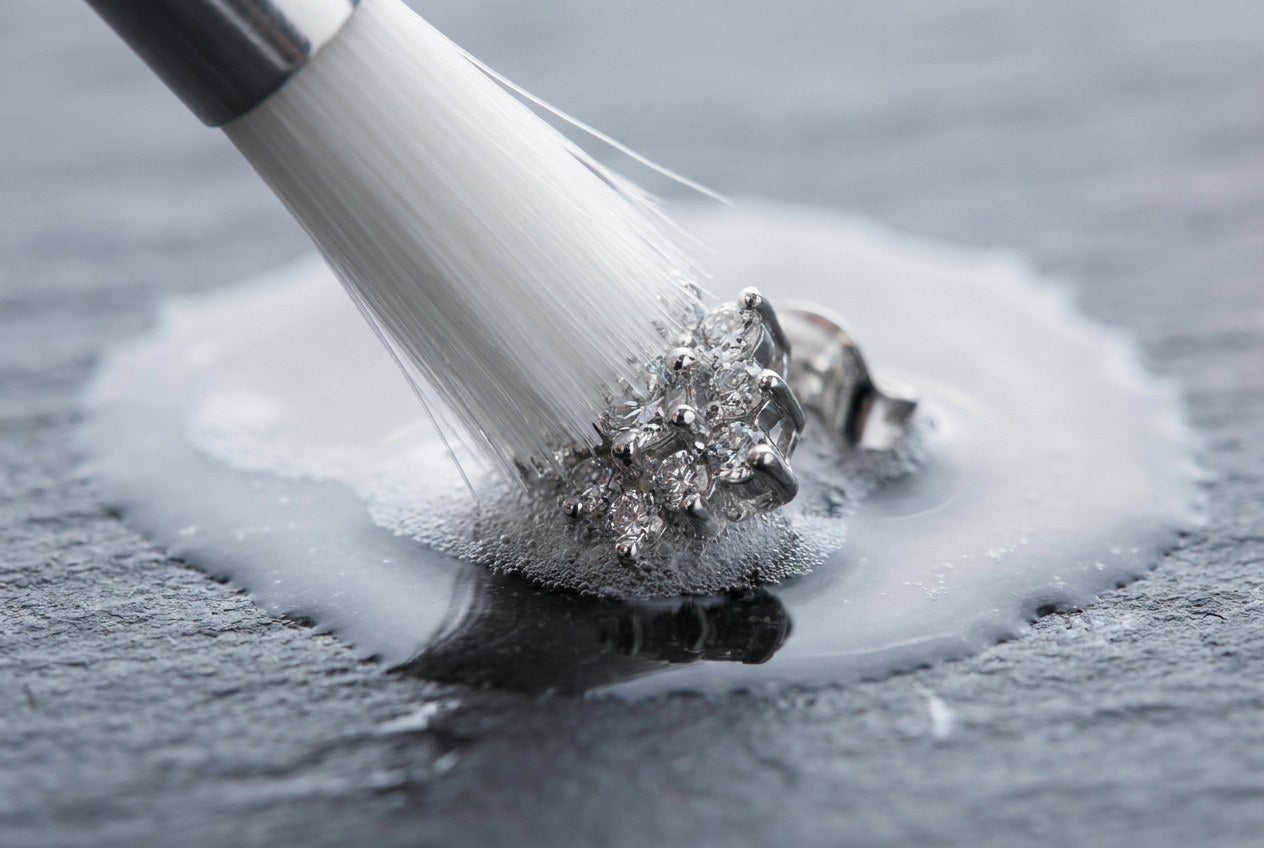
- Soak for five to ten minutes. This is the step doing the work. The soap breaks the surface tension so water can travel into those capillary gaps and lift the oily film out from behind the stones. Longer is fine. Pressure is not a substitute.
- Brush from behind and at an angle, not across the top. Turn the stud over and work the brush into the open gallery under the stone field first, then come at the face from the side so the bristles slide between the stones rather than skating over them. Light pressure. You are sweeping loosened film out of the gaps, not scouring anything off.
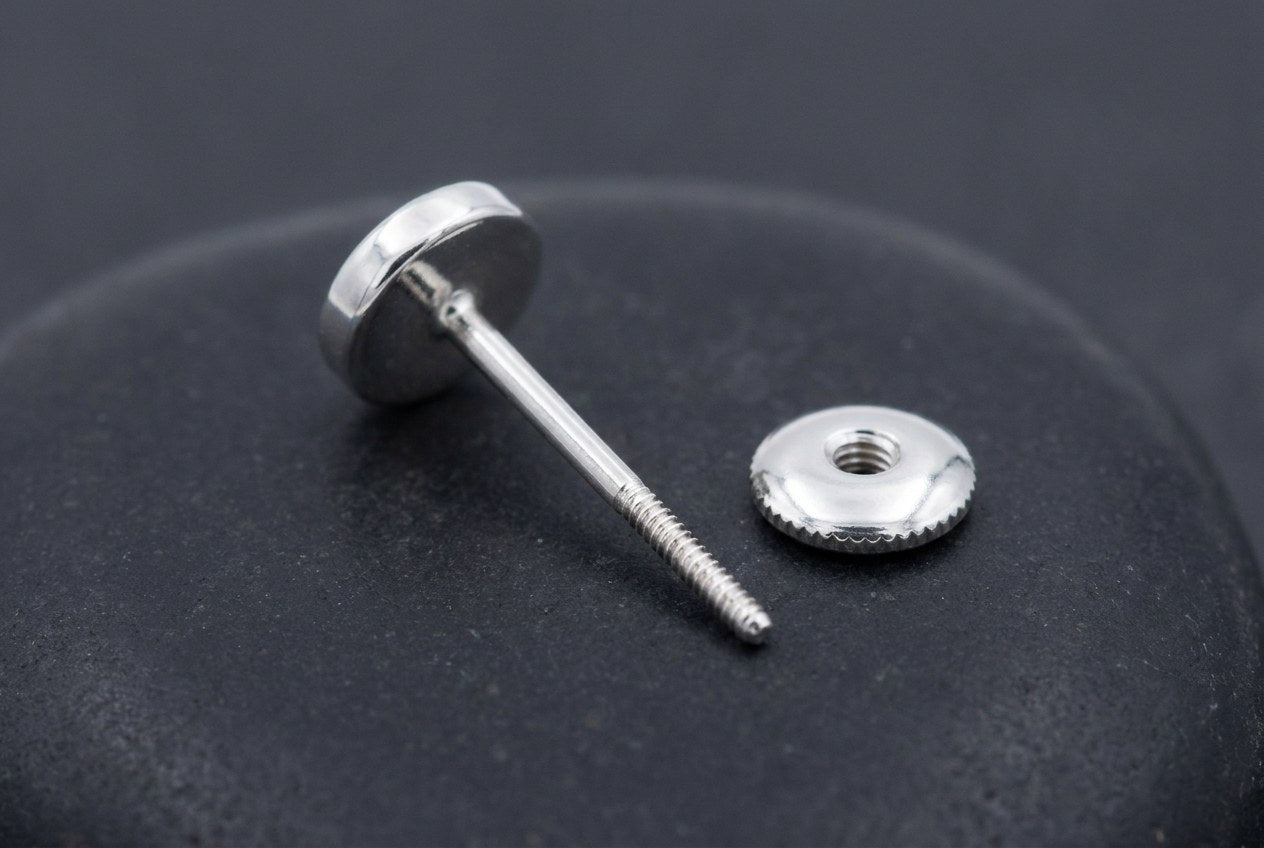
- Do the post and the threads. All of our studs use screw backs, and the threads are where residue quietly collects. A stiff back that will not turn smoothly is almost always dirty rather than damaged. Run the brush along the post, then along the inside of the threaded nut, and rinse both. Our guide to screw backs and push backs covers how the closure works and why it is worth keeping clean.
- Rinse in bowl two, not under the tap. GIA puts it plainly: "Be sure to rinse your jewelry in a glass of water to remove cleaning solutions since you risk losing loose stones, or even an entire piece of jewelry, if you rinse directly in the sink." A stud is small, wet and slippery, and a drain is unforgiving. Change the water once and dip again, because leftover soap dries as a haze in exactly the gaps you just cleaned.
- Dry the back, then let the front dry itself. Blot the gallery, the post and the threads with a lint-free cloth. Then stand the pair on edge or face down on the cloth for ten or fifteen minutes. Water wicked up under the stone field will not come out through a towel pressed on the front; it drains out the way it came in, and only if you give it somewhere to go and a little time.
- Give it thirty seconds of attention while it is clean. A dry, clean face is the only time you can properly see the setting. Look across the stones under a light and check that none sits lower or at a different angle than its neighbors. Press very gently on each edge with a fingertip. Anything that shifts, rattles or catches is a setting question, not a cleaning one.
If your pair is a gold or rose gold colorway
Every piece we make is built on solid .925 sterling silver, posts and backs included. The gold and rose gold colorways are plated over that same solid sterling base, and a plating layer is measured in microns.
Everything above still applies, with one change: keep a silver polishing cloth off it. A polishing cloth works by mild abrasion, which is exactly right on a smooth solid silver surface and exactly wrong on a plated one. It also cannot reach into a stone field anyway, so on a cluster stud it is doing very little on the front and quietly thinning the finish everywhere it does touch. Our article on what to expect from a plated finish goes through how plating ages and what shortens its life.
Worth knowing: our lifetime guarantee covers stone loss under normal wear, setting and clasp failure, and plating wear from normal wear, with re-plating included. Tarnish is not treated as a defect, because all silver tarnishes eventually and a polishing cloth reverses it in a minute. Full terms are on the lifetime guarantee page.
What to keep away from a stone-set stud
Short list, because our silver care guide covers the chemistry of each one properly.
- Anything abrasive. Toothpaste, baking soda, scouring powder. On a cluster setting an abrasive paste packs in behind the stones and stays there, and on a plated colorway it takes the finish with it.
- Instant silver dips. They etch, and a cluster face has dozens of places for the liquid to hide where you cannot rinse it out.
- Ultrasonic and steam cleaners. See the GIA line above on girdles touching. Not worth the risk on a face this densely set.
- Bleach, chlorine and acetone. Bad for sterling, and bad for any adhesive anywhere near a setting.
- Paper towels and tissues. Wood fiber is more abrasive on soft silver than people expect, and it leaves lint in the setting.
- Cleaning them in your ears. Worth repeating, because it is the most common shortcut and it is the one that puts soap where you cannot rinse it.
How often
For a pair worn most days, once a month is a sensible rhythm, plus a rinse and dry after anything that involved a lot of product in your hair. For a pair worn occasionally, clean it when you put it away rather than when you take it out, so it is not sitting in a box with a film on it for six months.
GIA's general recommendation for any set piece is that "jewelry should be checked every six months and cleaned frequently." The checking half is the part people skip, and on a face carrying a dozen or more small stones it is the half that catches a problem while it is still free to fix.
Our day-to-day guidance is the same as it is for the rest of the collection: remove pieces before showering, swimming, or applying perfume and hairspray, and store them in a dry pouch or the original box. More on wearing moissanite around the clock in can you wear moissanite every day.
Dirty, or actually dull?
After a proper clean and a full dry, look at the pair in indirect daylight rather than under a lamp. Lamps flatter everything. One of three things will be true.
| What you see | What it usually is | What to do |
|---|---|---|
| Whole face lifts and reads bright again | It was film, and it is gone | Nothing. Repeat monthly |
| Face is bright but one stone still reads grey | Film still trapped behind that stone | Soak again for longer and brush that spot from the back |
| A stone sits low, tilts, or moves under a fingertip | A setting issue, not a cleaning one | Stop cleaning it and contact us |
What it is almost certainly not is the stone going bad. Moissanite does not cloud, fade or lose its fire with age, and if a pair looks lifeless after a clean the cause is nearly always still on the piece somewhere. We took that question apart in does moissanite get cloudy, and if you want the background on the stone grade itself, what VVS moissanite actually means covers how clarity and color are described.
Frequently asked questions
How do I clean cluster earrings at home?
Soak them for five to ten minutes in warm water with one drop of mild dish soap, brush gently from behind the stone field with a soft brush, rinse in a second bowl of clean water rather than under the tap, blot the back dry and stand them on edge to finish air drying. No pastes, no dips, no machines.
Can I use an ultrasonic cleaner on pavé or cluster earrings?
We would not. GIA notes that ultrasonic vibration "can sometimes shake gems loose or cause damage if gems are set with their girdles touching", and that is exactly how a cluster face is built. The soap and water method reaches the same places with none of the risk.
Why do my earring backs turn stiffly?
Almost always residue in the threads rather than damage. Brush the post and the inside of the threaded nut during your normal clean, rinse and dry them fully, and the action usually comes back. If it still binds after that, stop forcing it and get in touch.
How do I clean gold plated earrings without wearing the finish off?
Same soak, same soft brush, same rinse. The one change is that a silver polishing cloth stays away from a plated surface, because it works by mild abrasion and the plating is only microns thick. Dry it properly and store it dry, and normal plating wear is covered by our lifetime guarantee anyway.
Is it safe to wear moissanite studs in the shower?
The stone is fine with water. The problem is everything else in a shower: shampoo and conditioner leave a film in a cluster setting that is genuinely hard to get back out, and soap residue is the usual reason a pair looks flat. Take them out.
How often should stone-set earrings be cleaned?
Monthly for a pair worn most days, and always before putting a pair away for a long stretch. GIA suggests having set jewelry checked every six months, which is a good rhythm for looking properly at the prongs rather than only at the sparkle.
The pair you already own, and where to start with a new one
None of this takes more than fifteen minutes, and most of that is soaking time you spend doing something else. A cluster stud that gets one honest clean a month will keep looking the way it did the day it arrived, because a stone-dense face hides the fine surface marks that show up on a plain polished band and it has no clasp to fail.
If you are looking for a first pair, the 9mm cluster studs are the everyday size and the 12mm cluster studs are the statement version, both cluster-set in solid .925 sterling silver on screw-back posts. Our 9mm versus 12mm comparison is the fastest way to decide between them, and how to choose an earring size helps if you are buying for someone else.
For something with a shaped face rather than a round cluster, the clover studs, the snowflake starburst studs and the hexagon statement studs all clean exactly the same way, and our comparison of princess-cut versus round moissanite studs is useful if you are choosing between a shaped face and a round one. The full range is in the earrings collection, and our moissanite earrings buying guide walks through metal, stones, size and backs before you choose.