

Home / Jamilah Jewels Blog | Moissanite, Jewelry Guides and Buying Advice / VVS Moissanite Chains: What the Grade Actually Buys You
VVS Moissanite Chains: What the Grade Actually Buys You
August 18, 2026

VVS is a clarity grade, and on a chain it buys you something different than it does on a ring. On a solitaire, clarity describes one stone you will look at closely for years. On a tennis chain there are well over a hundred small stones, none of which anyone will ever inspect individually. What the grade actually buys you there is consistency, meaning every stone in the row is clean enough that the line reads as one unbroken band of light instead of a run of bright stones with dull ones scattered through it.
That distinction matters because it changes what you should be checking before you spend $500 or more. Below is what the grade means on a chain, what it does not cover, and the parts of a chain that determine how it looks that have nothing to do with clarity at all.
What VVS means, briefly
VVS stands for Very Very Slightly Included. It is the second-highest clarity band, meaning any internal characteristics are so small that a trained grader needs 10x magnification to find them. D-color, which usually appears alongside it, is the top of the colorless scale, with no warm or yellow tint.
We have a full explanation of what VVS moissanite means and how the grades work, so this guide will not repeat it. What follows is specifically about what happens when that grade is applied to a hundred-plus stones on a chain rather than to one.
Why consistency is the real variable on a chain
Think about what your eye actually does when it looks at a tennis chain across a room. It does not resolve individual stones. It reads a line. And a line is only as good as its worst section.
One cloudy stone in a row of a hundred is not one percent of a problem. It is a visible dark spot in a band of light, and your eye goes straight to it. The same is true of a stone cut slightly shallower than its neighbors, or set a fraction lower, or a shade warmer in color. Any of those breaks the line.
This is why grade consistency is worth more on a chain than a high grade on any single stone. A chain of uniformly good stones outperforms a chain with a few exceptional stones and several mediocre ones, even if the average grade is identical. Buying a stated grade across the whole piece is buying the absence of that weak link.
The three things that break a row
- Clarity variation. A stone with a visible inclusion reads as a shadow rather than a highlight.
- Color variation. A warmer stone next to colder ones looks slightly dirty, even when it is perfectly clean.
- Cut variation. Stones cut to different depths return light at different angles, so some stay bright while others go dark as the chain moves.
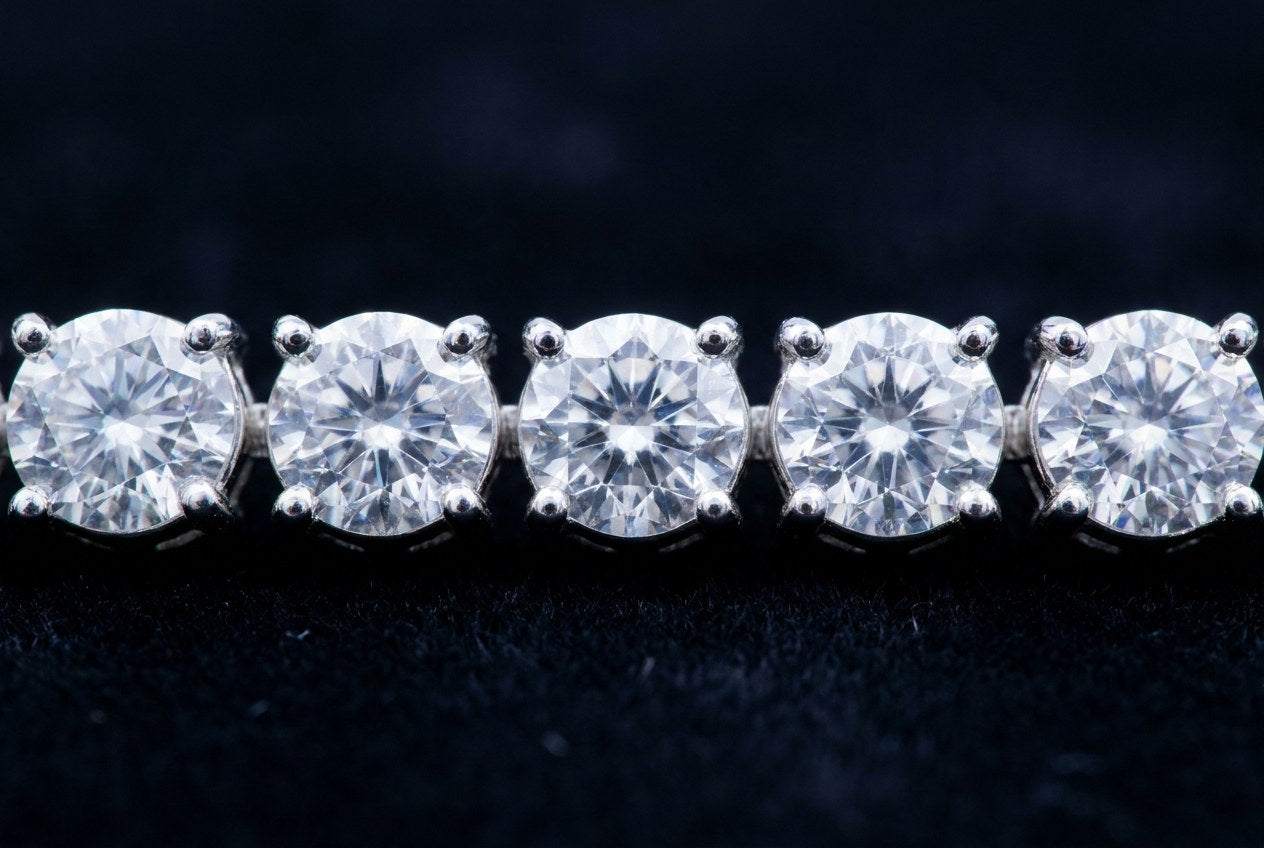
Cut is the one most people never think about and the one that does the most damage. A stone can be flawless and colorless and still look dead if it was cut badly, because brilliance comes from how the facets bounce light back out of the top. Precision cutting across every stone in a row is genuinely harder than getting a good grade on any one of them.
Single row or clustered: two different looks
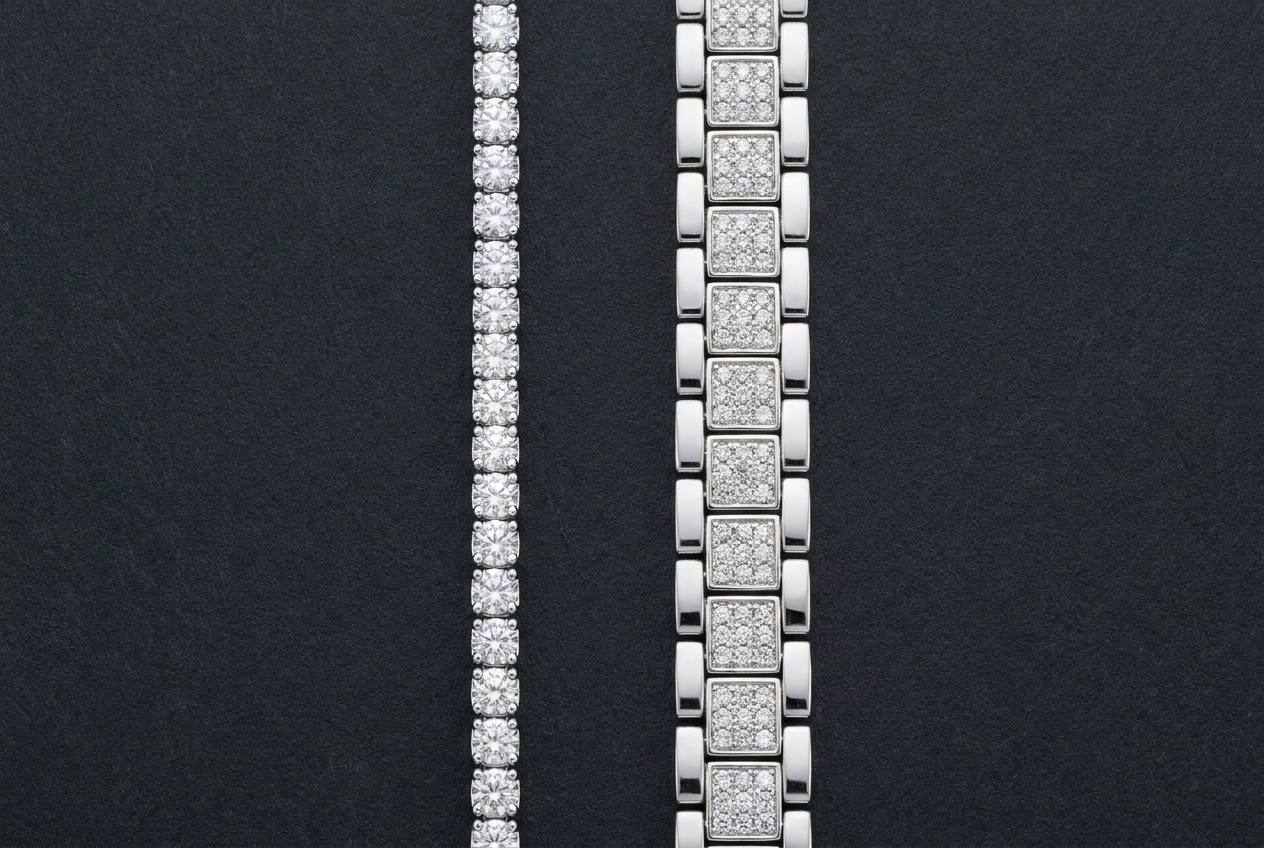
The other decision people are usually making when they search for a VVS chain is between a single row and a clustered setting. They are different products, not different price points of the same one.
| Style | How it reads | Best for |
|---|---|---|
| Single row | One clean line, even width | Layering, daily wear |
| Clustered | Wider, more texture | Worn on its own |
| Shaped link | Pattern over sparkle | Pairing a pendant |
A single-row tennis chain sets one stone per link in a continuous line. It is the cleanest look, it sits flattest against the neck, and it is the easiest to layer or wear under a pendant. Our 4mm Tennis Chain is this style, at $500 in 18 inch and $550 in 20 inch, in silver, gold, or rose gold.
A clustered setting groups several small stones into each link. It covers more surface, throws light from more angles, and reads considerably wider on the neck. The Rockstar Crown Spike Tennis Chain at $700 and the Butterfly 'Dreamline' Tennis Chain at $900 both work this way. Clustered pieces cost more for a straightforward reason: more stones, more settings, more hand-setting labor per inch.
Shaped-link chains such as the 'Flow State' Artistic Link Chain at $600 use the metal itself for the pattern with stones as accents. Because they are not competing for attention, these are the easiest chains to pair with an iced pendant, a point we go into properly in our guide to what chain to wear with a pendant.
What the grade does not tell you
This is the part most product pages leave out, and it is where the money actually goes.
The setting
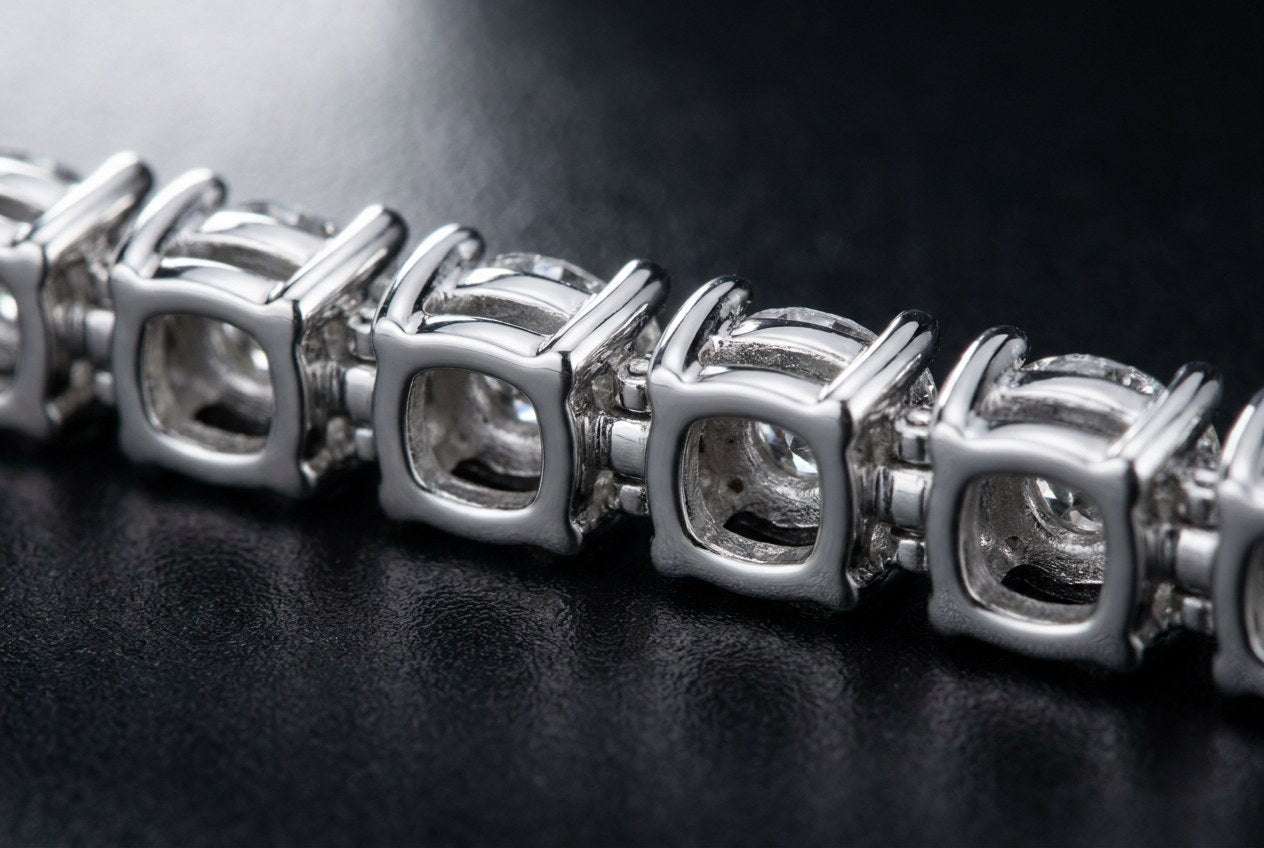
Every stone on a tennis chain sits in its own small setting, held by prongs, and each setting connects to the next by a link. That is a hundred-plus separate settings and a hundred-plus joints on a single chain. Stone quality has nothing to do with whether those prongs are finished properly or whether the links move freely. A chain fails at a prong or a clasp long before a stone fails. We covered how to read that construction in what makes iced-out jewelry look real.
The metal underneath
A chain can carry genuinely good stones and still be built on plated brass, in which case the plating wears at the contact points and the base metal shows through. Every Jamilah Jewels chain is solid .925 sterling silver throughout, with no brass, no stainless steel, and no mystery base metals. Gold and rose gold colorways are plated over that same solid sterling base, so as a finish wears the metal beneath it is still sterling rather than something else.
Whether the grade is certified
Here is the honest part, and almost nobody selling moissanite says it plainly: moissanite is generally not individually lab-certified the way a diamond is. When you see VVS and D-color on a moissanite listing, including ours, that is a manufacturer specification for the grade of material used, not a third-party certificate for the specific stone in front of you. There is no independent report accompanying a hundred small stones on a chain, from us or from anyone else.
We would rather tell you that than let you assume otherwise. It also means the useful check is not the certificate. It is the piece.
How to check a VVS claim before you buy
Since the grade is a specification rather than a certificate, judge the chain on what you can actually see.
- Look for a photograph of the real piece, not a render. Renders make every stone identical by definition, which is exactly the variable you are trying to assess.
- Look down the length of the row. In a good photo you can see whether the line is even or whether some stones sit brighter than others.
- Check that the metal is named specifically. ".925 sterling silver" is a claim. "Silver tone", "silver finish" and "925 plated" are not the same thing.
- Check what happens if a stone comes out. A stated grade means little from a seller with no position on stone loss.
- Be suspicious of a very low price on a very wide chain. A clustered chain has several times the stone count and setting labor of a single row. If it costs less, something was substituted.
On that last point, moissanite being reasonably priced is not itself suspicious, and there are real production reasons for it, which we explain in why moissanite is so cheap. What is suspicious is a wide, heavily set chain priced like a plain one.
Does the grade hold up over time?
Yes, and this is where moissanite has a genuine advantage over the material it is most often confused with. Moissanite sits at 9.25 on the Mohs hardness scale, just below diamond at 10. Household dust is around 7, which is what does the slow scratching on softer stones over years of wear.
Cubic zirconia sits around 8 to 8.5 and clouds noticeably with age as its surface accumulates fine abrasion. Moissanite does not do that. A VVS moissanite chain looks the same in five years as it does new, assuming the metal is looked after. Our comparison of how moissanite and cubic zirconia each age after a year goes into the detail.
What does change is the silver. Sterling tarnishes, which is a surface film rather than damage, and it comes off with a polishing cloth. The sterling silver care guide covers that, including the two common household products that permanently ruin silver.
Choosing a length
Briefly, because we have a whole guide on it. 18 inches sits at the base of the neck, at or just above the collarbone, and is the classic length for tennis chains. 20 inches falls just below the collarbone and is the most versatile length for men and the most popular for layering. 22 inches falls at or just above the chest and is best for a statement drop or for wearing over a hoodie.
If you are layering, keep at least two inches between lengths. Full measurements are in the tennis chain sizing guide, and if you want to see how the pieces work together, five ways to style a tennis chain covers the looks.
Frequently asked questions
VVS means Very Very Slightly Included, the second-highest clarity band, where any internal characteristics need 10x magnification to see. On a chain it applies to every stone in the row rather than to one stone, so what it really describes is the consistency of the whole line. It is a specification for the grade of material used, not a third-party certificate for each individual stone.
On a chain, yes, and more so than on a single-stone piece. A tennis chain is read as one continuous line of light, so one dull or off-color stone is visible from across a room. Paying for grade consistency across every stone is what stops that happening, and it matters more than an exceptional grade on any one stone.
Generally no. Unlike diamonds, moissanite is usually not individually lab-certified, so a VVS D-color listing describes the grade of material a manufacturer used rather than a report on the specific stone. This is true across the industry, not just of any one seller. Judge the piece on the metal, the setting, real photographs, and what the seller guarantees.
A tennis chain sets one stone per link in a single continuous row, giving a clean even line that sits flat and layers easily. A clustered chain groups several small stones into each link, so it is wider, more textured, and throws light from more angles. Clustered chains cost more because they carry more stones and more setting work per inch.
The stones will not. Moissanite is 9.25 on the Mohs scale, hard enough that ordinary dust does not abrade it, so it does not cloud the way cubic zirconia does. The sterling silver will tarnish over time, which is a surface film rather than damage and comes off with a silver polishing cloth.
On our chains it is covered. Our lifetime guarantee covers stone loss, setting and prong failure, clasp failure, and plating wear from normal wear with re-plating included. It does not cover loss, theft, or accident damage.
The short version
On a chain, the grade is not about any one stone. It is about whether all of them match well enough that the row reads as a single clean line. Check that the metal is named as solid .925 rather than plated or "silver tone", look at real photographs rather than renders, understand that the grade is a manufacturer specification rather than a certificate, and find out what the seller does when a prong lets go. Those four things tell you more about a chain than the grade on the listing does.
Chains in solid .925 sterling silver
Every chain is solid .925 sterling silver set with VVS D-color lab-grown moissanite, backed by our lifetime guarantee, with free fully insured US shipping and 30-day returns. Not sure which style suits you? Message us and we will tell you honestly.
Related guides: What Is VVS Moissanite? | Tennis Chain Sizing Guide | What Chain to Wear With a Pendant | What Makes Iced-Out Jewelry Look Real | Moissanite Tennis Bracelet Buying Guide