

Home / Jamilah Jewels Blog | Moissanite, Jewelry Guides and Buying Advice / Moissanite Tennis Bracelet Buying Guide: Width, Fit, and Style
Moissanite Tennis Bracelet Buying Guide: Width, Fit, and Style
August 5, 2026

A tennis bracelet is one of the few pieces of jewelry where the difference between "perfect" and "not quite right" comes down to two numbers you choose before you order: the width of the stones and the length of the line. Get those right and the bracelet looks like it was made for your wrist. Get them wrong and it either disappears or slides around all day.
The short answer
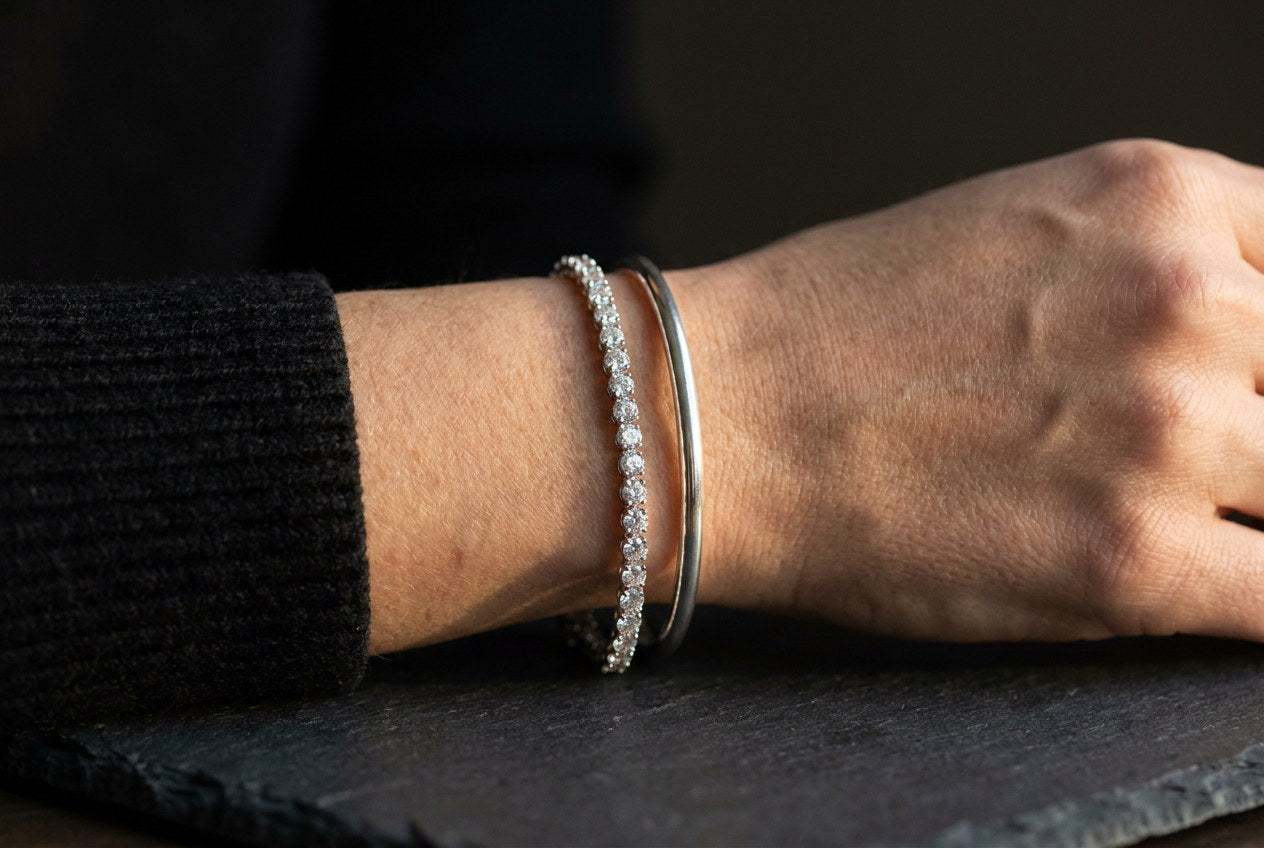
For most people, a 4mm moissanite tennis bracelet in a 7" length is the safest first buy. The 4mm width reads clearly from across a room without overwhelming an average wrist, and 7" is the standard women's size that fits wrists up to about 6.25". If you have a wrist between 6.5" and 7.25" — which covers most men and some women — take the 8". Go slimmer, to 3mm, if you plan to stack the bracelet with a watch or other pieces and want it to sit quietly alongside them.
Everything below is the reasoning behind that, plus the parts of a tennis bracelet that matter but rarely get explained: the setting, the clasp, and what the metal underneath the stones is actually made of.
What makes a tennis bracelet a tennis bracelet
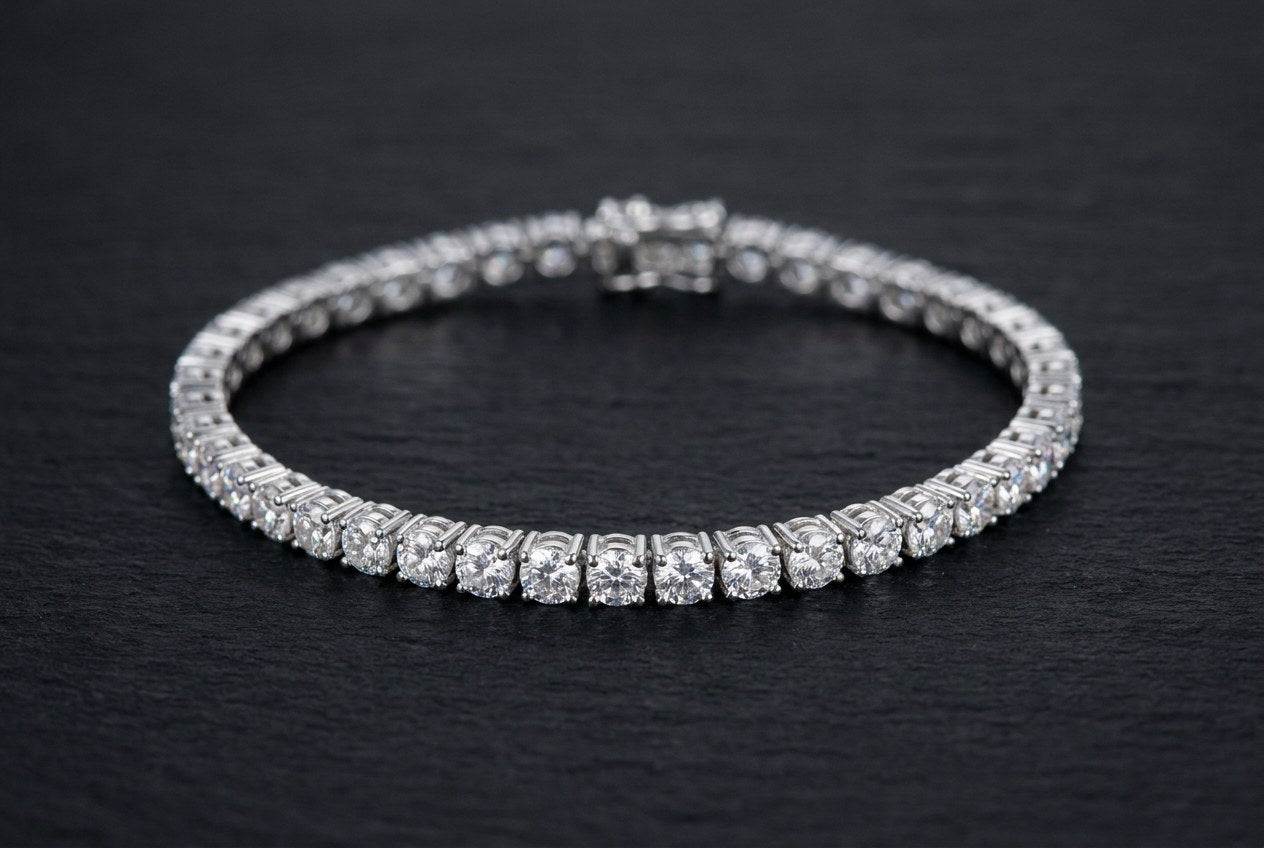
A tennis bracelet is a flexible line of identically sized stones, each individually set, running the entire way around the wrist with no gaps and no central focal point. That continuous, symmetrical line is the whole design. There is no pendant, no clasp feature, nothing to draw the eye to one spot — which is exactly why it works with everything.
The name is the accidental part. The style was sold as a "diamond line bracelet" for decades. The story usually told is that during the 1987 US Open, Chris Evert's line bracelet came loose mid-match and she asked officials to pause play while she found it. The style has been called a tennis bracelet ever since.
At Jamilah Jewels the same construction is used with lab-created moissanite instead of diamond, set in solid .925 sterling silver. The look is the same. The price is not.
Width: 3mm or 4mm?
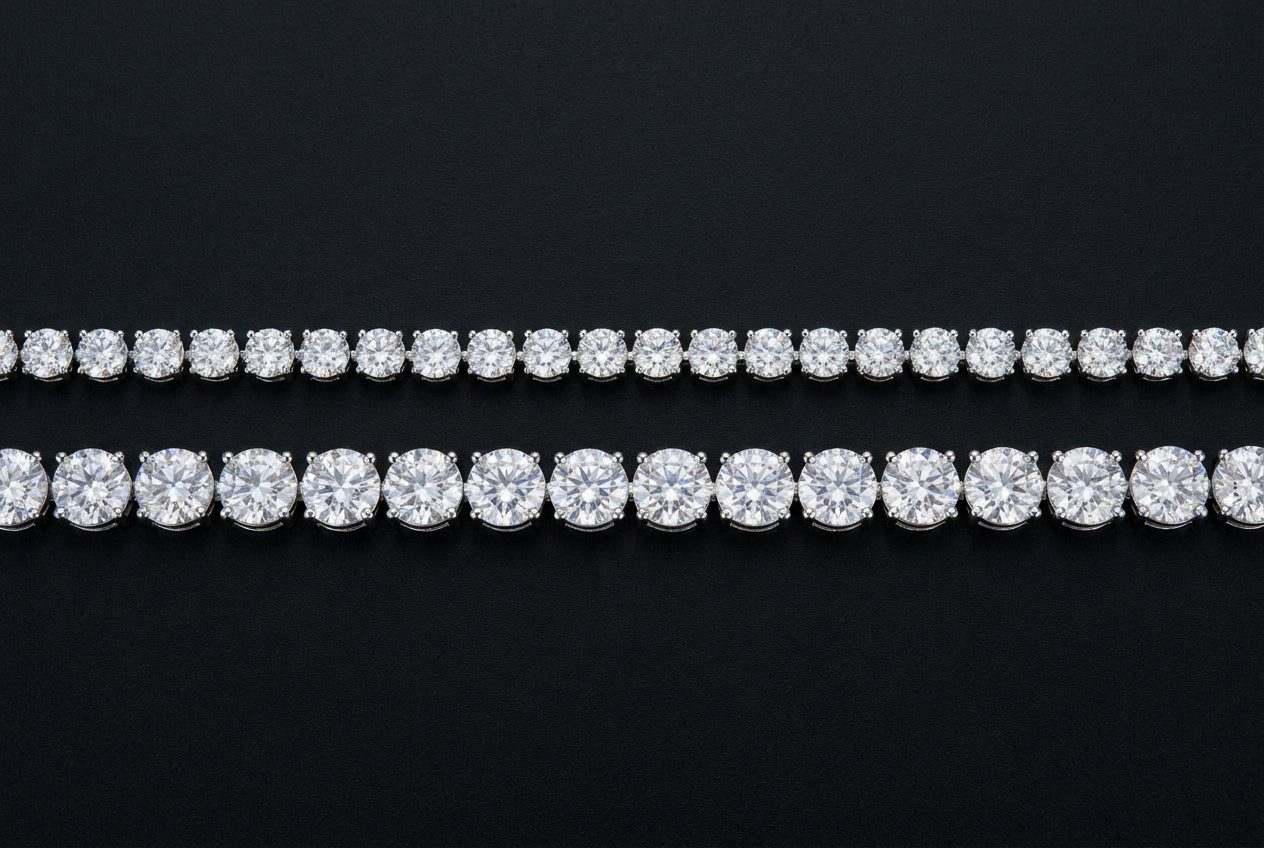
Width is measured across a single stone, and it is the single biggest decision you make. A millimeter sounds like nothing. On a wrist it is the difference between a piece that whispers and one that announces itself.
3mm — the everyday and stacking width
A 3mm line is slim enough to wear under a shirt cuff without catching, and it layers cleanly next to a watch or a bangle without competing. It is the width to choose if you want something you genuinely never take off, or if you have a smaller wrist where a wider line would dominate. The 3mm Luxe Clover Tennis Bracelet ($450) uses this width with clover-shaped links instead of plain rounds, which gives it a bit more personality while keeping the slim profile.
4mm — the classic statement width
4mm is the width most people picture when they think "tennis bracelet." Each stone is large enough to be read individually rather than as a general shimmer, so the bracelet works on its own with nothing else on the wrist. This is the width to pick if the bracelet is the piece, not part of a stack. Our 4mm Tennis Bracelet with round-cut lab stones ($350) is the direct version of this, available in silver, gold and rose gold finishes in both 7" and 8".
| Width | Best for | Stacks? | Reads as |
|---|---|---|---|
| 3mm | Daily wear, smaller wrists, layering | Yes — built for it | Soft, even shimmer |
| 4mm | Wearing solo, evenings, gifting | Works, but leads | Stones read one by one |
If you are choosing between the two and cannot decide, ask yourself what else you wear on that wrist. A watch on the same arm pushes the answer toward 3mm. An empty wrist pushes it toward 4mm.
Length: how to get the fit right the first time
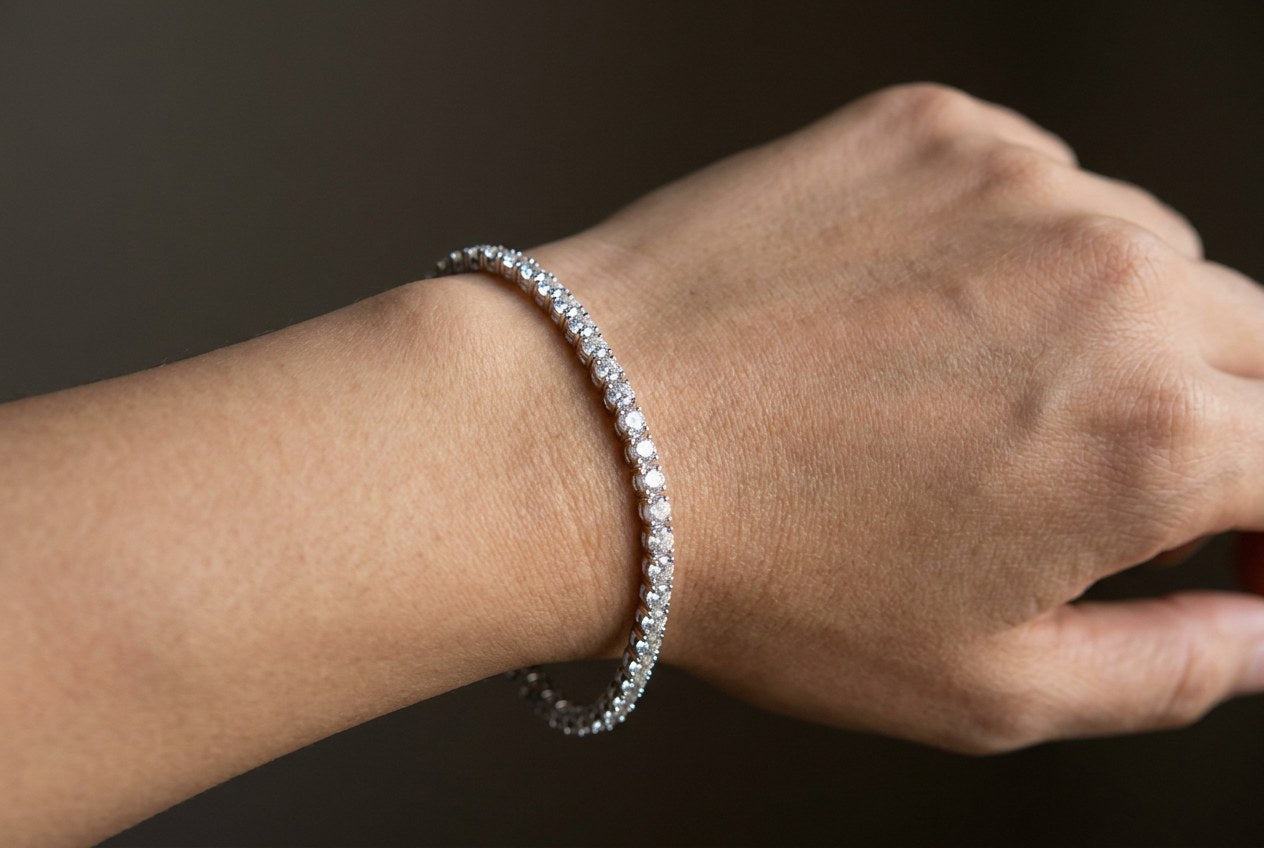
A tennis bracelet is meant to move. It should rotate freely around the wrist and slide down toward the hand when you drop your arm, but it should not clear the widest part of your hand. Too tight and the line kinks against the skin instead of lying flat; too loose and it spins so the clasp ends up on top.
Measure your wrist in thirty seconds
Wrap a strip of paper or a piece of string around your wrist, just below the wrist bone, snug but not tight. Mark where it overlaps, lay it flat against a ruler, and read the measurement. That number is your wrist size — not your bracelet size. Then use this:
| Your wrist measures | Order | How it will sit |
|---|---|---|
| Up to 6.25" | 7" | Comfortable movement, sits at the wrist bone |
| 6.5" – 7.25" | 8" | Relaxed drape, slides toward the hand |
Both of those figures come straight from our size guide. If you land exactly on the boundary, take the larger size — a bracelet that is slightly generous still looks correct, while one that is slightly short does not. And if you are buying as a gift and cannot measure, 7" is the far more common women's size.
What VVS and D-color actually mean here
Search for a moissanite tennis bracelet and you will see "VVS1" and "D-color" on almost every listing, including ours. Here is the honest version of what those terms do and do not tell you.
VVS describes clarity — very, very slightly included. In practice it means the stone is eye-clean: no inclusions you can see without magnification. D-color means colorless, with no warm or yellow tint. Both are real, meaningful descriptions of what you are getting, and both matter more on a bracelet than almost anywhere else, because a tennis bracelet puts dozens of stones in a straight line where any inconsistency in color between them is immediately obvious.
What those grades are not is a third-party certificate. Diamonds are graded by independent labs against a standardized scale. Moissanite generally is not — the grading language is borrowed from the diamond world and applied by the manufacturer. That does not make it dishonest; it makes it a description rather than a certification, and it is worth knowing the difference. We wrote a fuller explanation in what VVS moissanite actually means, and if you are still deciding between stones entirely, our moissanite versus diamond comparison covers the trade-offs without the sales pitch.
One thing worth stating plainly: moissanite is not a diamond. It is silicon carbide, a separate gemstone with its own optical properties — noticeably more fire, slightly lower hardness at 9.25 on the Mohs scale against diamond's 10. It is its own material and it is excellent at being that.
The metal underneath matters more than the stones
This is the part most buying guides skip, and it is where cheap tennis bracelets fail. The stones are the hard part of the piece. Moissanite at 9.25 Mohs is not going to be the thing that gives out. The metal holding it is.
Every Jamilah Jewels bracelet is built on solid .925 sterling silver — not plated base metal, not brass with a silver wash. When a bracelet is offered in gold or rose gold, that color is plating applied over the same solid sterling silver base underneath. That distinction matters because plating over brass eventually wears through to a different metal; plating over sterling wears through to sterling.
Sterling silver sits around 2.5 to 3 on the Mohs scale, which is soft. It will pick up fine surface scratches over years of wear, and it will tarnish if it is left sitting in a humid bathroom. Neither is a defect — it is what silver does, and both are reversible. Our sterling silver care guide covers what to do about it, including the two household cleaning tricks that quietly destroy a piece.
Setting and clasp: the two things that decide whether it lasts
On a tennis bracelet, every stone is held by its own tiny setting, usually four prongs. That means a 7" bracelet has somewhere around fifty individual settings, each one a potential point of failure. Well-made settings sit level with each other, hold the stone tight enough that it does not rattle, and have prongs that end flush rather than sticking up to snag on fabric.
The clasp is the other failure point, and it is the reason a tennis bracelet needs a safety catch as well as a primary closure. A box clasp with a figure-eight safety latch is the standard, and it is what you want — a single spring-ring closure on a bracelet you wear daily is asking for a loss.
Every piece we sell carries a lifetime guarantee covering stone loss, setting and clasp failure, and re-plating, which is the practical version of that same point: settings and clasps are the parts that fail, so those are the parts worth guaranteeing.
Which style suits you
Our moissanite tennis bracelet collection keeps four distinct designs rather than a dozen near-identical ones. Here is the honest positioning of each.
The classic — 4mm round cut
The 4mm Tennis Bracelet ($350) is the traditional design: an unbroken line of round brilliant stones, nothing else. Available in silver, gold and rose gold, 7" and 8". If you want the piece everyone recognizes as a tennis bracelet, this is it, and at $350 it is the most accessible entry point in the collection.
The everyday — 3mm clover
The 3mm Luxe Clover Tennis Bracelet ($450) trades the plain round line for clover-shaped links. Slimmer, more detailed up close, and the easiest of the four to wear seven days a week. Silver, gold or rose gold, 7" and 8".
The statement — baguette butterfly
The Baguette Butterfly Tennis Bracelet ($500) uses baguette-cut stones — rectangular step cuts that throw broad flashes of light rather than the scattered sparkle of round brilliants — accented with butterfly detailing. Sterling silver, 7" and 8". This is the one that gets asked about.
The soft option — rose gold butterfly
The Rose Gold-Plated Butterfly Tennis Bracelet ($350) runs three butterfly charms along a standard tennis line, with rose gold plating over the sterling base for a warmer tone against the skin. Currently 8" only.
If none of those is quite it, the wider bracelet collection includes non-tennis designs — the 'Forged Spirit' nail bracelet, the 'True Motion' bangle and the 'Never Ending' infinity loop among them.
Can you get a custom moissanite tennis bracelet?
Yes. Custom work is a real part of what we do, not an afterthought — a customizable moissanite tennis bracelet can be built to a specific length, a specific stone width, or a colored-stone layout that is not in the standing collection. Custom pieces can also be made with lab-grown or natural diamonds instead of moissanite, and in solid gold rather than plated sterling, if that is the direction you want.
The trade-off is worth knowing before you start: custom pieces are final sale, because they are made to your specification and cannot be resold. Start at the custom collection to see the range of what has been built.
How to wear it
A tennis bracelet is one of the least fussy pieces of jewelry there is. Some things that help:
- Stack on the same wrist as your watch, not the opposite one. Two separate wrists reads as cluttered; one loaded wrist reads as deliberate.
- Match metal tones within a stack, but don't force it across the whole outfit. Silver bracelet with a silver watch. Your earrings are far enough away not to matter.
- Let it sit over the cuff, not under it, with a jacket. A bracelet hidden under a sleeve is a bracelet nobody sees.
- Pair widths rather than repeating them. A 3mm tennis bracelet next to a plain bangle works. Two 4mm lines next to each other fight.
For more on building a full look around one piece, iced-out moissanite for women and how to style a tennis chain both cover the same logic applied elsewhere. Men buying for daily wear should read what actually holds up in men's moissanite jewelry first.
Keeping it looking new
Moissanite handles daily wear well, and the practical care rules are short:
- Warm water, a drop of dish soap, a soft toothbrush along the underside of the stones where oils collect. Once a month is plenty.
- Take it off before the shower, the pool and the gym. Not because the stone minds, but because soap film dulls the sparkle and chlorine is hard on silver.
- Store it flat in a pouch or a lined box, not loose in a drawer with other pieces.
- Put jewelry on last, after perfume and lotion.
If a bracelet starts looking dull, it is almost always surface film rather than anything happening inside the stone — does moissanite get cloudy explains what is actually going on, and can you wear moissanite every day covers the shower, gym and sleep questions properly.
Frequently asked questions
What size moissanite tennis bracelet should I buy, 7" or 8"?
Measure your wrist with a strip of paper. If it is up to 6.25", order the 7". If it is between 6.5" and 7.25", order the 8". On the boundary, size up.
Is a 4mm moissanite tennis bracelet too big for a small wrist?
Not too big, but it will be the dominant piece on that wrist. On a wrist under about 6", a 3mm line generally looks more in proportion, particularly if you wear a watch on the same arm.
What does VVS1 mean on a moissanite tennis bracelet?
VVS1 describes clarity — the stone is eye-clean with no inclusions visible without magnification. Combined with D-color it means colorless and clean. It is a manufacturer description rather than an independent lab certification, which is standard across moissanite.
Are these real 925 sterling silver moissanite tennis bracelets?
Yes. Every piece is built on solid .925 sterling silver. Gold and rose gold versions are that same sterling base with plating applied over it, not a different base metal.
Can I get a custom or customizable moissanite tennis bracelet?
Yes — custom length, stone width and stone color are all possible, and custom pieces can be made in solid gold or with lab-grown or natural diamonds. Custom orders are final sale.
Do moissanite bracelets tarnish?
The moissanite does not. The sterling silver around it can tarnish over time, especially in humidity, which is normal for silver and fully reversible with a polishing cloth. Tarnish is not covered by our lifetime guarantee because it is not a defect; the guarantee covers stone loss, setting and clasp failure, and re-plating.
Can you wear a moissanite tennis bracelet every day?
Yes. Moissanite at 9.25 on the Mohs scale is one of the hardest materials used in jewelry. The limiting factor is the silver, which is soft and will pick up fine scratches — an expected part of wearing silver, not a fault.
What is the best moissanite tennis bracelet to start with?
The 4mm round-cut at $350 in whichever length fits your wrist. It is the classic design, the most versatile, and the least likely to be a piece you outgrow.
Ready to choose
Measure your wrist, pick your width, pick your finish. That is the whole decision. Every bracelet ships free and fully insured within the US in two to five business days, comes with a lifetime guarantee covering stone loss, setting and clasp failure, and re-plating, and can be returned within 30 days unworn and in original packaging, with return shipping covered on approved returns and no restocking fee.
Shop the moissanite tennis bracelet collection, or browse the full bracelet range if you want to see everything side by side. Questions about sizing or a custom build are answered on our FAQ page.